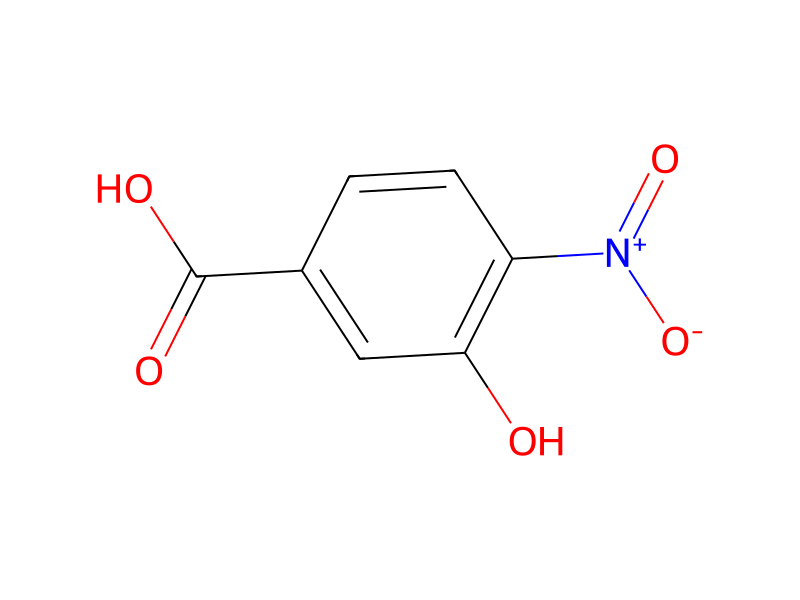
Acetyl chloride → Methyl 3-hydroxy-4-nitrobenzoate
Reaction equation

[OH:1][C:2]1[CH:3]=[C:4]([CH:8]=[CH:9][C:10]=1[N+:11]([O-:13])=[O:12])[C:5]([OH:7])=[O:6].[C:14](Cl)(=O)C>CO>[OH:1][C:2]1[CH:3]=[C:4]([CH:8]=[CH:9][C:10]=1[N+:11]([O-:13])=[O:12])[C:5]([O:7][CH3:14])=[O:6]Participants
4
Reactant 2

Product 1

Reagents, catalysts & solvents 1

Procedure
3-Hydroxy-4-nitrobenzoic acid (I) (100.3 g, 95% pure, 0.53 mole) was added to methanol (1250 ml) to which had been added acetyl chloride (25 ml). The solid dissolved over a period of two days. After six days, the solution was filtered to remove undissolved impurities. The crude ester was obtained by evaporation of the solution. Several crops of crystals were taken, the last from a 50 ml volume. The combined crops were recrystalized from methanol (150 ml). Two crops of the ester (II) as yellow-brown crystals, m.p. 89°-91°, (98.7 g, 0.50 mole) were obtained.
Workup
- dissolutionThe solid dissolved over a period of two days
- filtrationthe solution was filtered
- customto remove undissolved impurities
- customThe crude ester was obtained by evaporation of the solution
- customThe combined crops were recrystalized from methanol (150 ml)
Sources & evidence
- ORD record
- ord-802b356c9f844fbdb0b2893a78ec1ac7
- Source dataset
- uspto-grants-1985_02
- Patent number
- US04501692
Reaction notes
Loading…