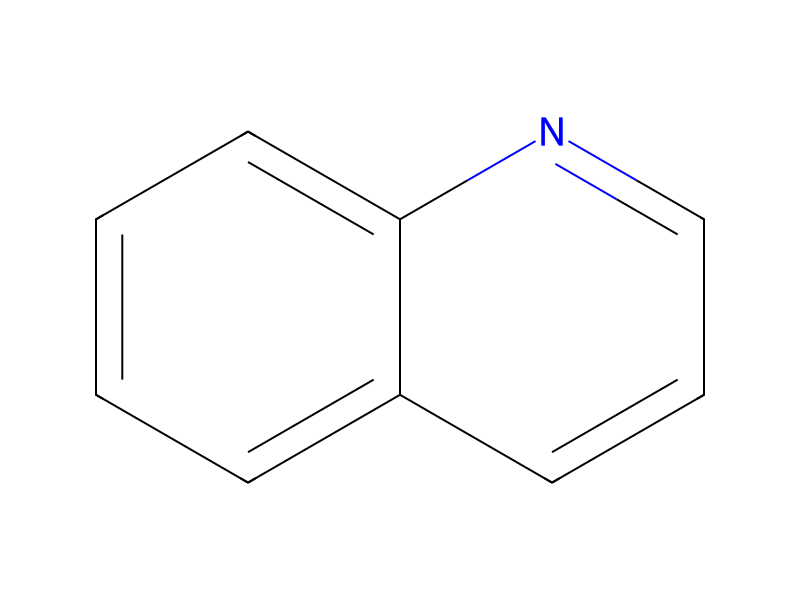
Quinoline → 6,6'-Methylene-bis-(2,2,4-trimethyl decahydroquinoline)
Reaction equation

N1C2C(=CC=CC=2)C=CC=1.CC1(C)C=C(C)C2C(=CC=CC=2)N1.CC1(C)CC(C)C2C(CCCC2)N1.[CH2:37]([C:51]1[CH:52]=[C:53]2[C:58](=[CH:59][CH:60]=1)[NH:57][C:56]([CH3:62])([CH3:61])[CH:55]=[C:54]2[CH3:63])[C:38]1[CH:39]=[C:40]2[C:45](=[CH:46][CH:47]=1)[NH:44][C:43]([CH3:49])([CH3:48])[CH:42]=[C:41]2[CH3:50]>>[CH2:37]([CH:38]1[CH2:47][CH2:46][CH:45]2[CH:40]([CH:41]([CH3:50])[CH2:42][C:43]([CH3:48])([CH3:49])[NH:44]2)[CH2:39]1)[CH:51]1[CH2:60][CH2:59][CH:58]2[CH:53]([CH:54]([CH3:63])[CH2:55][C:56]([CH3:61])([CH3:62])[NH:57]2)[CH2:52]1Participants


Procedure
As previously mentioned, dimer compounds and bis compounds of the novel substituted decahydroquinolines can also be prepared and used as effective UV stabilizers. Dimer and bis intermediate products can be prepared by hydrogenation of the unsaturated quinoline dimer or bis compound. For example, 6- 4'-(2,2,4-trimethyl-1,2-dihydroquinolyl)!-2,2,4-trimethyl-1,2-dihydroquinoline, which is the dimer of 2,2,4-trimethyl-1,2-dihydroquinoline (TMDQ) and which is prepared in small quantities as a by-product in the preparation of TMDQ, can be hydrogenated using a metal catalyst to yield a dimer compound, i.e., 6- 4'-(2,2,4-trimethyldecahydroquinolyl)!-2,2,4-trimethyl decahydroquinoline. This compound can then be further reacted at the nitrogen atom to yield compounds of the invention. As a further example, in the article by D. Craig in the J. Amer. Chem. Soc., Vol. 60 (1938), page 1458 et seq., the author prepared the material 6,6'-methylene-bis-(2,2,4-trimethyl-1,2-dihydroquinoline). This material can be hydrogenated using a metal catalyst to yield a bis compound, i.e., 6,6'-methylene-bis-(2,2,4-trimethyl decahydroquinoline), which can then be further reacted at the nitrogen atom to yield a bis compound of the invention such as 6,6'-methylene-bis-(1-ethyl-2,2,4-trimethyl decahydroquinoline). In yet a further example, two moles of 2,2,4-trimethyl decahydroquinoline can be reacted with a dihaloalkane such as 1,10-dibromodecane to yield a bis compound of the invention, i.e., 1,10-bis- 1-(2,2,4-trimethyl decahydroquinolyl)!-decane. Other examples of dimer and bis compounds of the invention are 6- 4'-(1-ethyl-2,2,4-trimethyl decahydroquinolyl)!-1-ethyl-2,2,4-trimethyl decahydroquinoline; 8- 4'-(1-hydroxyethyl-2,2,4-trimethyl decahydroquinolyl)!-1-hydroxyethyl-2,2,4-trimethyl decahydroquinoline; 1,2-bis- 1-(2,2,4-trimethyl decahydroquinolyl)!ethane; 1,4-bis 1-(2-methyl-2,4-dihexyl decahydroquinolyl)!butane; 1,6-bis- 1-(2-methyl-2,4-diethyl decahydroquinolyl)!hexane; 1,6-bis- 4-(1,2,2,4-tetramethyl decahydroquinolyl)!hexane; bis- 2-(2,2,4-trimethyl decahydroquinolin-1-yl)ethyl!ether; bis- 4-(2-methyl-2,4-diethyl decahydroquinolin-1-yl)butyl!ether; bis- 2-(1,2-dimethyl-2-ethyl decahydroquinolin-4-yl)ethyl!sulfide; bis- 2-(1-hydroxy-ethyl-2,2-dimethyl decahydroquinolin-4-yl)ethyl!amine; 1,4-bis- (2,2,4-trimethyl decahydroquinolin-1-yl)methyl! cyclohexane; 1,4-bis 2-(1,2,4-trimethyl-2-ethyl decahydroquinolin-6-yl)ethyl!benzene; and the like.
Workup
- customto yield a dimer compound, i.e., 6- 4'-(2,2,4-trimethyldecahydroquinolyl)
- customThis compound can then be further reacted at the nitrogen atom
- customto yield compounds of the invention
Sources & evidence
- ORD record
- ord-3043ca7c4c0a4f7780648805b08b6c91
- Source dataset
- uspto-grants-1978_02
- Patent number
- US04073770
Reaction notes
Loading…