Pyridinium chloride → HCID 9798304, compound
Reaction equation
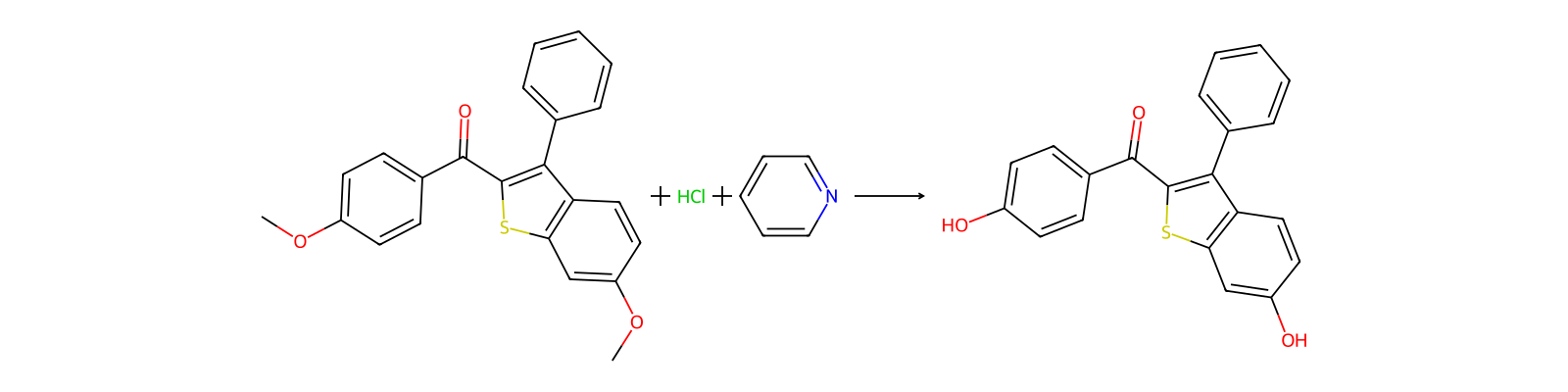
C[O:2][C:3]1[CH:27]=[CH:26][C:6]([C:7]([C:9]2[S:10][C:11]3[CH:23]=[C:22]([O:24]C)[CH:21]=[CH:20][C:12]=3[C:13]=2[C:14]2[CH:19]=[CH:18][CH:17]=[CH:16][CH:15]=2)=[O:8])=[CH:5][CH:4]=1.Cl.N1C=CC=CC=1>>[OH:2][C:3]1[CH:4]=[CH:5][C:6]([C:7]([C:9]2[S:10][C:11]3[CH:23]=[C:22]([OH:24])[CH:21]=[CH:20][C:12]=3[C:13]=2[C:14]2[CH:15]=[CH:16][CH:17]=[CH:18][CH:19]=2)=[O:8])=[CH:26][CH:27]=1Participants
3



Conditions
- Temperature
- 220 °C
Procedure
A mixture of 8.75 g. (0.023 mole) of the product from Example 7 and 25 g. of pyridine hydrochloride was prepared. The mixture was refluxed in a 220° C. oil bath for 30 minutes. The hot reaction mixture then was poured over ice, and the resulting mixture was added to a blender. The resulting yellow crystals were collected on a filter, washed with water, and vacuum dried at 100° C. This treatment caused some resinification of the sample. The residue was recrystallized from a mixture of ethyl acetate and benzene to obtain 5.3 g. (65 percent) of the title compound as bright yellow crystals, m.p. 198°-200° C.
Workup
- additionA mixture of 8.75 g
- additionThe hot reaction mixture then was poured over ice
- additionthe resulting mixture was added to a blender
- customThe resulting yellow crystals were collected on a filter
- washwashed with water, and vacuum
- customdried at 100° C
- customThe residue was recrystallized from a mixture of ethyl acetate and benzene
- customto obtain 5.3 g
Sources & evidence
- ORD record
- ord-826178dcd8f9419b93d6794445e835d6
- Source dataset
- uspto-grants-1978_02
- Patent number
- US04075227
Reaction notes
Loading…