Sulfur Dioxide → Sulfuric Acid
Reaction equation

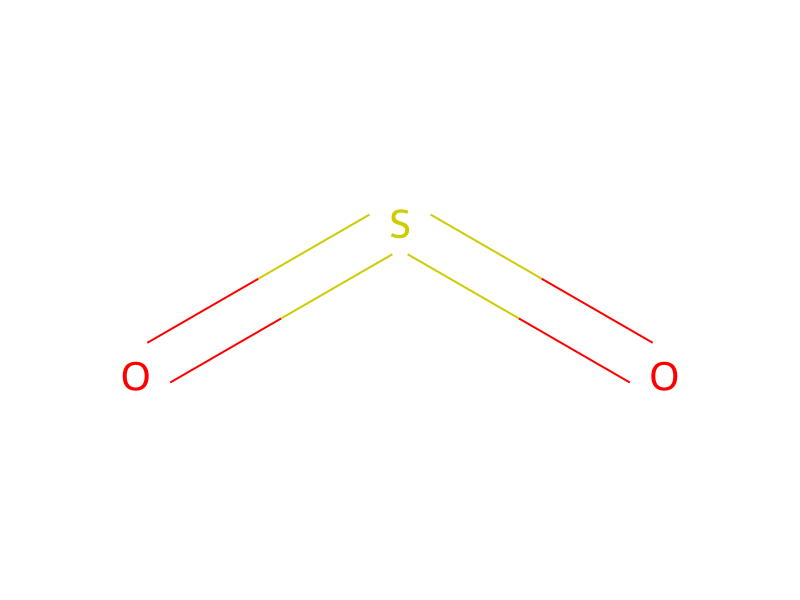
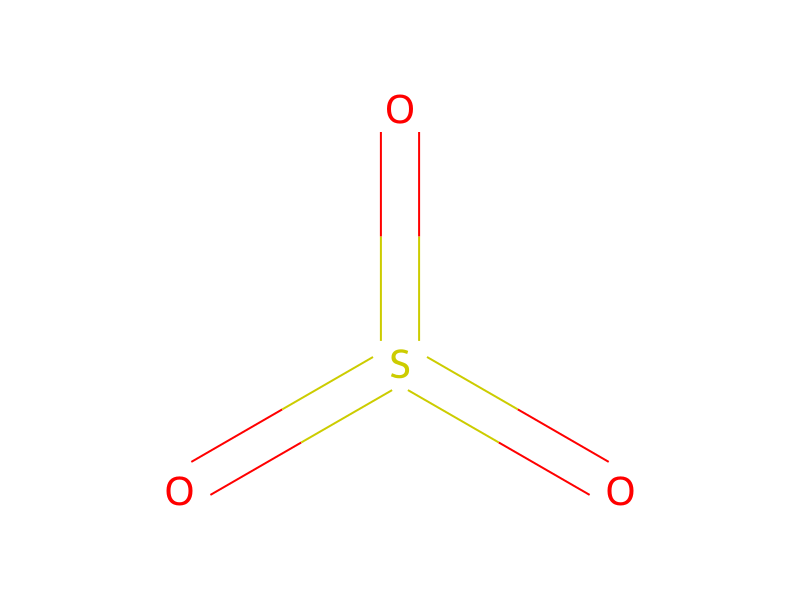
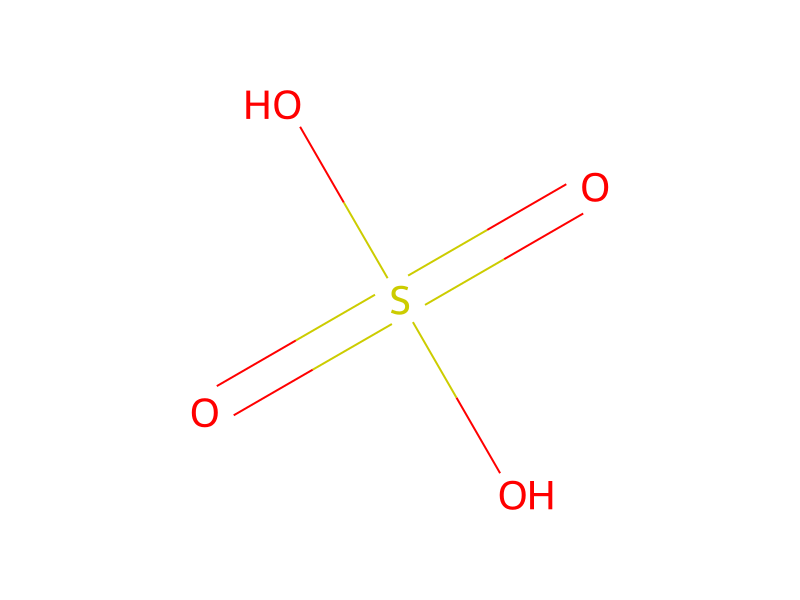
[Cl:1][C:2]1[C:7]([Cl:8])=[C:6]([Cl:9])[C:5]([Cl:10])=[C:4]([Cl:11])[C:3]=1[CH3:12].S(=O)=[O:14].[S:16](=[O:19])(=[O:18])=[O:17]>>[S:16](=[O:14])(=[O:19])([OH:18])[OH:17].[Cl:1][C:2]1[C:3]([CH2:12][OH:14])=[C:4]([Cl:11])[C:5]([Cl:10])=[C:6]([Cl:9])[C:7]=1[Cl:8]Participants


Procedure
Liquid sulfur trioxide, (200 ml, 385 g) was added to 26.4 g. (0.1 mole) of pure 2,3,4,5,6-pentachlorotoluene (mp 224°-225° C) placed in a 500 ml 3-neck tared flask provided with stirrer, thermometer and reflux condenser the end of which was attached to a bubble counter so that the rate of gas evolution during the reaction can be visually estimated. External heat was applied to the flask to bring the sulfur trioxide to reflux. Soon a light blue color developed, which turned gradually deeper to a vivid royal blue. The color change was accompanied by gas evolution which was identified as sulfur dioxide. The steady gas evolution, which began after 10 minutes of reflux, lasted for 2-3 hours, after which it became gradually slower and the reaction mixture gradually acquired a dark green-grey color. The weight of the reaction mixture at this time indicated a loss of 6.9 g, as compared to the theoretical loss of 6.4 g, corresponding to one mole of sulfur dioxide evolved. The excess of sulfur trioxide, which acted also as a solvent during the reaction was distilled off first at atmospheric pressure, then under aspirator vacuum at a temperature not exceeding 70° C. The weight (45.2 g) of the product, a greenish-grey solid, indicated the C7H3Cl5O7S2 composition and this was confirmed by its hydrolysis which yielded 0.2 moles of sulfuric acid and 0.1 mole of pentachlorobenzyl alcohol, identified by elemental analysis, infrared spectroscopy, melting point and nuclear magnetic resonance spectroscopy (see Example 23). The evolvement of the reaction was also followed by nuclear magnetic resonance (nmr) spectroscopy which indicated that even in the early stages of the reaction the characteristic proton resonance of pentachlorotoluene at 2.52 ppm downfield from tetramethylsilane (TMS) completely disappeared. Instead, a new peak at 4.55 ppm appeared, which is assignable to the radical cation formed from pentachlorotoluene by the loss of one electron. During the refluxing and sulfur dioxide evolution period two additional peaks developed in increasing intensities and in approximately in a 2:1 ratio at 6.29 and 9.21-9.60 ppm (the latter is somewhat variable during the reaction). The former corresponds to the two benzylic hydrogens adjacent to the oxonium moiety and the latter corresponds to the acidic proton of the sulfuric acid moiety. The intensity of the peak corresponding to the radical cation, which accounts for the intense blue color, diminishes to a few percent after 2 hours of reflux and the intensities of the protons of the oxonium compound become constant after this period.
Workup
- customprovided with stirrer
- temperaturethermometer and reflux condenser the end of which
- customwas attached to a bubble counter so that the rate of gas evolution during the reaction
- temperatureExternal heat
- temperatureto reflux
- temperatureof reflux
- waitlasted for 2-3 hours
- distillationwas distilled off first at atmospheric pressure
- customexceeding 70° C
- customthis was confirmed by its hydrolysis which
Sources & evidence
- ORD record
- ord-1d464d2ff1584054b3f15c0374f21157
- Source dataset
- uspto-grants-1978_02
- Patent number
- US04075238
Reaction notes
Loading…