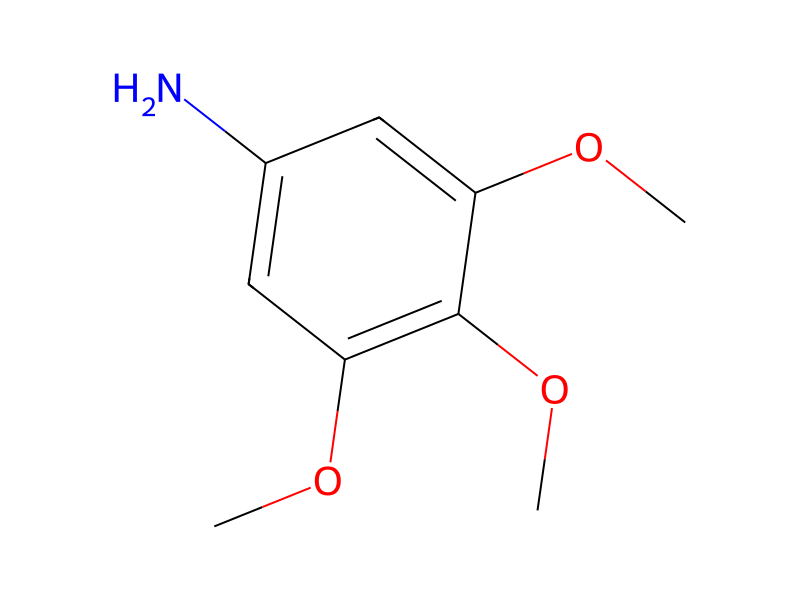
3,4,5-Trimethoxyaniline → HCID 21995314, compound
Reaction equation

CS([C:5]1[N:10]=[C:9]([O:11][C:12]2[CH:17]=[CH:16][CH:15]=[CH:14][CH:13]=2)[CH:8]=[CH:7][N:6]=1)(=O)=O.[CH3:18][O:19][C:20]1[CH:21]=[C:22]([CH:24]=[C:25]([O:29][CH3:30])[C:26]=1[O:27][CH3:28])[NH2:23]>>[O:11]([C:9]1[CH:8]=[CH:7][N:6]=[C:5]([NH:23][C:22]2[CH:24]=[C:25]([O:29][CH3:30])[C:26]([O:27][CH3:28])=[C:20]([O:19][CH3:18])[CH:21]=2)[N:10]=1)[C:12]1[CH:17]=[CH:16][CH:15]=[CH:14][CH:13]=1Participants


Procedure
2-Methylsulphonyl-4-phenoxypyrimidine (0.76 g, 3.04 mmol) and 3,4,5-trimethoxyaniline (0.56 g, 4.0 mmol) were heated as a melt at 1400 for 2 h. On cooling the residue was partitioned between ethyl acetate (50 ml) and 2M hydrochloric acid (50 ml), and the organic layer was washed with water (50 ml), dried (MgSO4) and concentrated under reduced pressure. The residue was subjected to column chromatography [silica 20% ethyl acetate-hexane] to give the title compound (18 mg) as a white solid m.p. 149° after recrystallisation from ethyl acetate. δH (CDCl3) 8.26 (1H, d, J 5.6 Hz), 7.39 (2H, m), 7.26 (1H,m), 7.18-7.15 (2H, m), 6.73 (2H, s), 6.31 (1H, d, J 5.6 Hz), 3.77 (3H, s) and 3.64 (6H, s). MS m/z 354 (M+H)+. The pyrimidine used as starting material was prepared by the addition of 50% 3-chloroperoxybenzoic acid (15.19 g, 88.0 mmol) to a solution of 4-phenoxy-2-thiomethylpyrimidine (5.0 g, 22.9 mmol) in CH2Cl2 (100 ml) at 0°. The resulting mixture was allowed to rise to room temperature over 12 h, and was then washed with 2M aqueous NaOH (2×100 ml), saturated aqueous sodium sulphite (2×100 ml), dried (MgSO4) and concentrated under reduced pressure. The residue was subjected to column chromatography to give the desired product (0.81 g) as a colourless oil. δH (CDCl3) 8.49 (1H, d, J 5.5 Hz), 7.45 (2H, t, J 8.0 Hz), 7.33-7.26 (1H, m), 7.19-7.16 (2H, m), 6.85 (1H, d, J 5.5Hz) and 3.23 (3H, s). The 4-phenoxy-2-thiomethylpyrimidine used as starting material was prepared by heating a solution of 4-fluoro-2-thiomethylpyridine [N. Pleet al., J. Het. Chem. 31, 1311-1315 (1994)] (9.98 g, 69.3 mmol) and phenol (6.58 g, 70.0 mmol) in dry DMF (100 ml) in the presence of caesium carbonate (22.8 g, 70.0 mmol) at 400 for 6 h. The reaction was concentrated in vacuo and the residue was partitioned between ethyl acetate (100 ml) and water (100 ml). The organic layer was dried (MgSO4), concentrated under reduced pressure and the residue subjected to column chromatography [silica 40% ethyl acetate-hexane] to give the desired product (7.01 g) as a colourless oil. δH (CDCl3) 8.33 (1H, dd, J 4.7, 0.9 Hz), 7.40 (2H, dd, 8.0,1.1 Hz), 7.26 (1H, m), 7.23 (2H, m), 6.46 (1H, dd, J 4.7, 0.9Hz) and 2.37 (3H, s). MS m/z 219 (M+H)+.
Workup
- temperatureOn cooling the residue
- customwas partitioned between ethyl acetate (50 ml) and 2M hydrochloric acid (50 ml)
- washthe organic layer was washed with water (50 ml)
- dry with materialdried (MgSO4)
- concentrationconcentrated under reduced pressure
Sources & evidence
- ORD record
- ord-573f79d7b8224137a3c991d0536dfeca
- Source dataset
- uspto-grants-1999_09
- Patent number
- US05958935
Reaction notes
Loading…