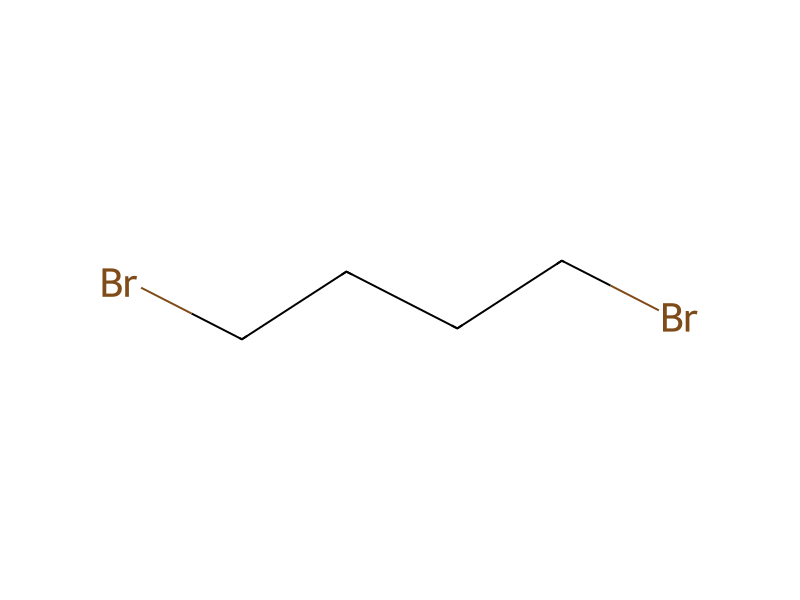
1,4-Dibromobutane → 4-(4-Acetyl-3-hydroxy-2-propylphenoxy)butyl bromide
Reaction equation

[OH:1][C:2]1[C:7]([CH2:8][CH2:9][CH3:10])=[C:6]([OH:11])[CH:5]=[CH:4][C:3]=1[C:12](=[O:14])[CH3:13].[Br:15][CH2:16][CH2:17][CH2:18][CH2:19]Br.C(=O)([O-])[O-].[K+].[K+]>CCC(C)=O.[I-].[K+]>[OH:1][C:2]1[C:7]([CH2:8][CH2:9][CH3:10])=[C:6]([O:11][CH2:19][CH2:18][CH2:17][CH2:16][Br:15])[CH:5]=[CH:4][C:3]=1[C:12](=[O:14])[CH3:13]Participants





Procedure
2', 4'-dihydroxy-3'-(n-propyl)acetophenone (19.1 g), 1,4-dibromobutane (48 ml, 0.4 moles), potassium carbonate (13.8 g), and potassium iodide (50 mg) were combined in MEK (300 ml). The reaction mixture was stirred and heated to reflux temperature overnight then cooled to room temperature. The cooled solution was partitioned between ethyl acetate and water. The organic layer was separated, dried over magnesium sulfate, filtered and concentrated in vacuo. The concentrate was chromatographed on a preparatory-scale HPLC (silica column) eluted with a gradient of 1 to 20% ethyl acetate in hexane to yield 11.2 g of the title product: n.m.r. (300 MHz, CDCl3) δ: 12.8 (s, 1H); 7.6 (d, 1H); 6.45 (d, 1H); 4.1 (t, 2H); 3.55 (t, 2H); 2.7 (t, 2H); 2.65 (s, 3H); 2.25 (m, 2H); 2.05 (m, 2H); 1.58 (m, 2H); 0.98 (t, 3H).
Workup
- temperatureheated
- temperatureto reflux temperature overnight
- customThe cooled solution was partitioned between ethyl acetate and water
- customThe organic layer was separated
- dry with materialdried over magnesium sulfate
- filtrationfiltered
- concentrationconcentrated in vacuo
- customThe concentrate was chromatographed on a preparatory-scale HPLC (silica column)
- washeluted with a gradient of 1 to 20% ethyl acetate in hexane
Sources & evidence
- ORD record
- ord-71eadbe877d24c7eac95357c874ca528
- Source dataset
- uspto-grants-1989_04
- Patent number
- US04820723
Reaction notes
Loading…