Benzene, 1-(chloromethyl)-3(or 4)-ethenyl- → HCID 178418369, compound
Reaction equation

C(C(Cl)C1C=CC=CC=1)=C.[C:11]1([C:17]2[NH:21][N:20]=[N:19][N:18]=2)[CH:16]=[CH:15][CH:14]=[CH:13][CH:12]=1.[Na].C(C1C=CC=CC=1CN1C(C2C=CC=CC=2)=NN=N1)=C.C(C1(C=CC=CC1)CN1C(C2C=CC=CC=2)=NN=N1)=C>COCCO>[C:11]1([C:17]2[NH:21][N:20]=[N:19][N:18]=2)[CH:12]=[CH:13][CH:14]=[CH:15][CH:16]=1Participants
Reactant 4


Product 1
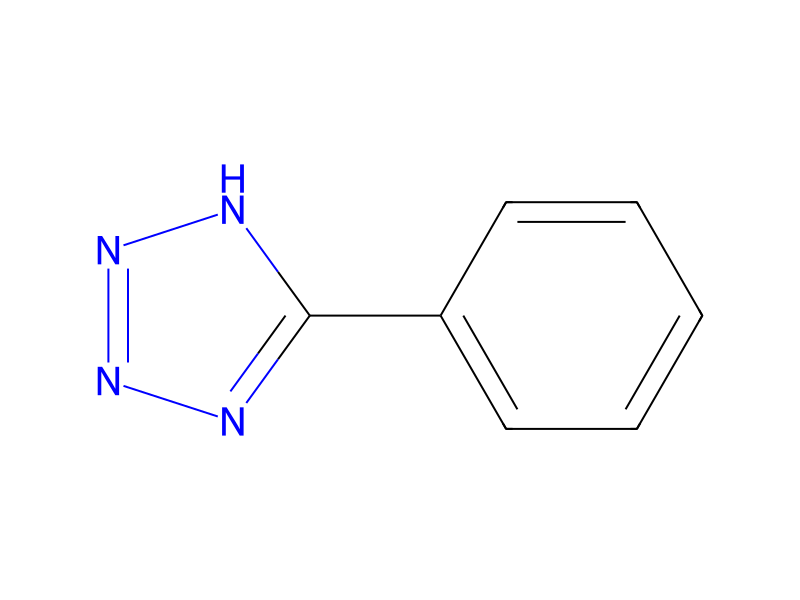
Reagents, catalysts & solvents 1

Conditions
- Temperature
- 100 °C
Procedure
Vinylbenzyl chloride (0.10 mole; 15.3 g, 60 percent meta-/40 percent para; Dow Experimental Monomer XC1915.00 stabilized with 5-butyl catechol (50 ppm) and nitromethane (700-1000 ppm)) was dissolved in 2-methoxyethanol (250 ml). This solution was added to a solution of sodium 5-phenyltetrazole (0.11 mole; 18.5 g) in 2-methoxyethanol and the reactants heated at 100° C. / 15 hours. The mixture was quenched with H2O (700 ml), extracted with CH2Cl2 (2×200 ml), the extracts washed with H2O (500 ml) and concentrated to give a viscous liquid (weight 26.0 g; 98.8 percent , yield). Mass spectral assay (electron impact and chemical ionization) showed a molecular weight ion peak at 262 (theor. 262.34). 13C NMR confirmed the presence of two isomers (3.65/1 ratio) corresponding to 2-vinylbenzyl 5-phenyltetrazole and 1-vinylbenzyl 5-phenyl-tetrazole. Elemental analysis found: C, 71.06; H, 5.42; N, 20.51; Cl, 1.43. Calculation for C16H14N4 : C, 73.26; H, 5.38; N, 21.38.
Workup
- customThe mixture was quenched with H2O (700 ml)
- extractionextracted with CH2Cl2 (2×200 ml)
- washthe extracts washed with H2O (500 ml)
- concentrationconcentrated
- customto give
- customa viscous liquid (weight 26.0 g; 98.8 percent , yield)
Sources & evidence
- ORD record
- ord-e3ec97b8936a486196d4cd22109ed4d5
- Source dataset
- uspto-grants-1988_09
- Patent number
- US04774266
Reaction notes
Loading…