Water → (1S,2S,3S,4R,5S)-5-{4-Chloro-3-[4-(2-hydroxy-ethoxy)-benzyl]-phenyl}-1-hydroxymethyl-6,8-dioxa-bicyclo[3.2.1]octane-2,3,4-triol
Reaction equation

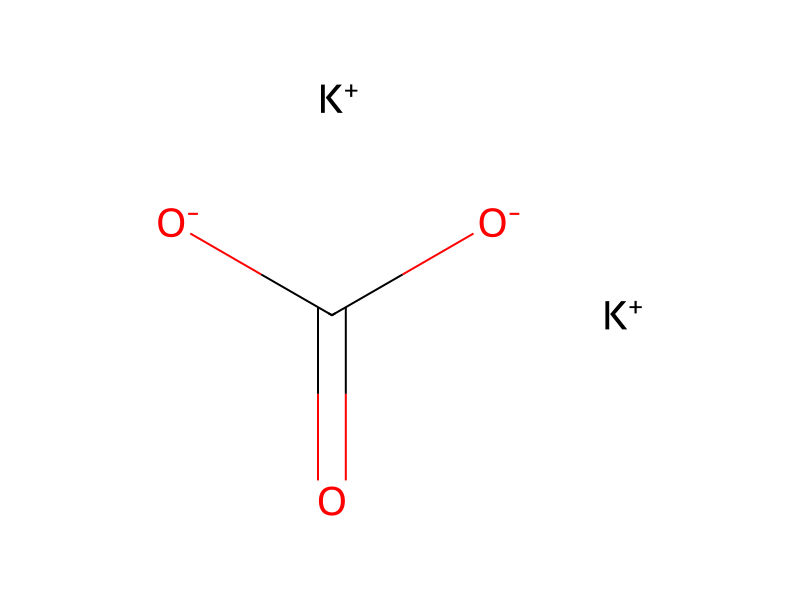
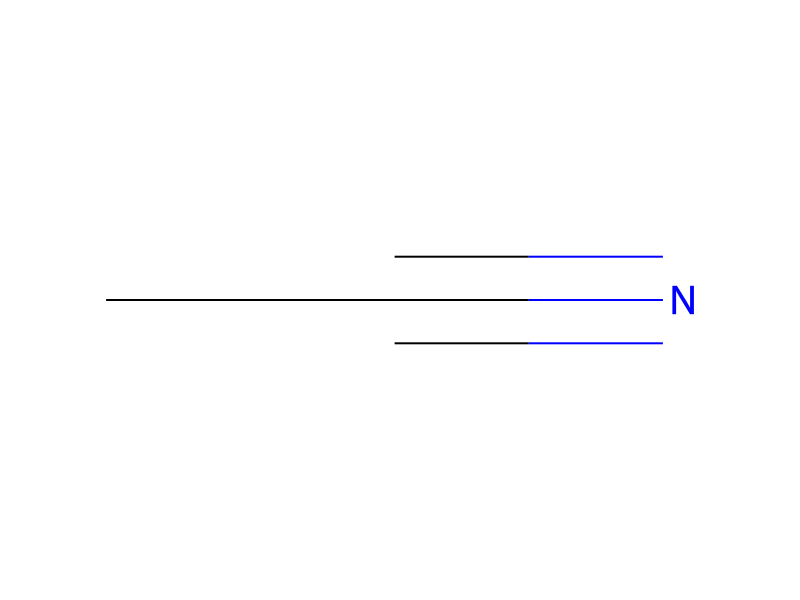
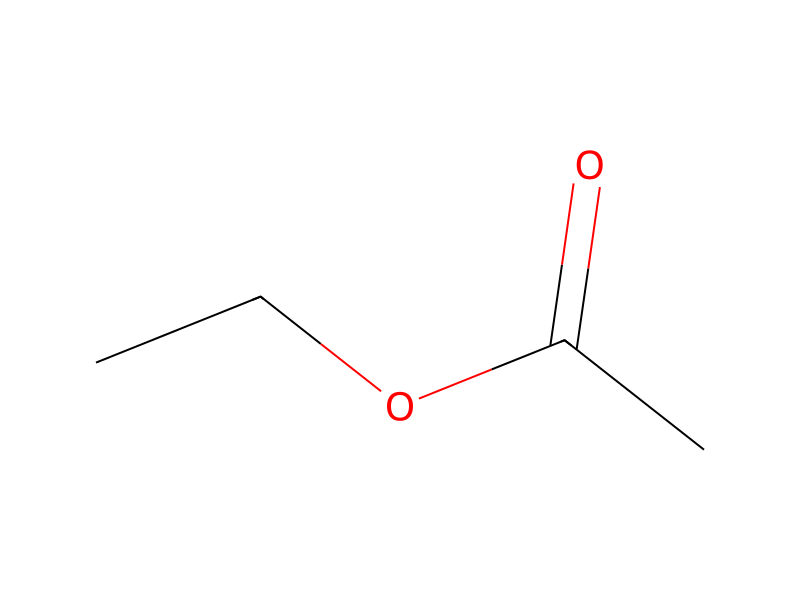
[Cl:1][C:2]1[CH:7]=[CH:6][C:5]([C@@:8]23[O:15][C@@:12]([CH2:16][OH:17])([CH2:13][O:14]2)[C@@H:11]([OH:18])[C@H:10]([OH:19])[C@H:9]3[OH:20])=[CH:4][C:3]=1[CH2:21][C:22]1[CH:27]=[CH:26][C:25]([OH:28])=[CH:24][CH:23]=1.C(=O)([O-])[O-].[K+].[K+].Br[CH2:36][CH2:37][O:38]CC1C=CC=CC=1.O>C(#N)C.C(OCC)(=O)C>[Cl:1][C:2]1[CH:7]=[CH:6][C:5]([C@@:8]23[O:15][C@@:12]([CH2:16][OH:17])([CH2:13][O:14]2)[C@@H:11]([OH:18])[C@H:10]([OH:19])[C@H:9]3[OH:20])=[CH:4][C:3]=1[CH2:21][C:22]1[CH:23]=[CH:24][C:25]([O:28][CH2:36][CH2:37][OH:38])=[CH:26][CH:27]=1Participants
Reactant 4
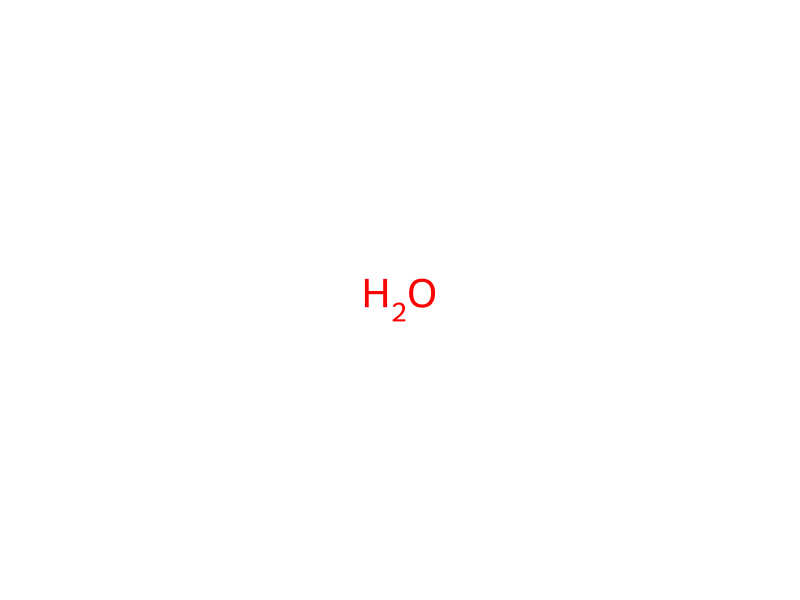


Product 1

Reagents, catalysts & solvents 2
Procedure
To a solution of (1S,2S,3S,4R,5S)-5-[4-chloro-3-(4-hydroxy-benzyl)-phenyl]-1-hydroxymethyl-6,8-dioxa-bicyclo[3.2.1]octane-2,3,4-triol (14 mg, 0.034 mmol) in acetonitrile (0.5 mL) was added potassium carbonate (14 mg, 0.1 mmol) followed by the addition of (2-bromo-ethoxymethyl)-benzene (0.010 mL, 0.063 mmol) and the reaction mixture was heated to 50 degrees Celsius for 24 hours. The reaction showed some product formation but the majority of starting material remained. An additional 3 equivalents of potassium carbonate was added, the temperature was increased to 83 degrees Celsius and the reaction mixture stirred for an additional 5 hours. The reaction mixture was cooled to room temperature, water (20 mL) and ethyl acetate were added, the organic phase separated and the aqueous phase was extracted 3 times with ethyl acetate (20 mL). The combined organic layers were washed with brine, dried over sodium sulfate, filtered and concentrated under reduced pressure. The crude material was purified by flash chromatography over silica gel using the ISCO automated chromatography unit (4 g silica gel column) and eluting with a gradient of 0 to 23% methanol in dichloromethane. 4 mg of the desired compound (1S,2S,3S,4R,5S)-5-(3-(4-(2-(Benzyloxy)ethoxy)benzyl)-4-chlorophenyl)-1-(hydroxymethyl)-6,8-dioxabicyclo[3.2.1]octane-2,3,4-triol was obtained. LCMS 587 (M+HCO2−, negative mode). 1H NMR (500 MHz, METHANOL-d4) delta ppm 3.56 (d, J=8.1 Hz, 1H), 3.60 (d, J=7.6 Hz, 1H), 3.63-3.67 (m, 1H), 3.69 (d, J=12.7 Hz, 2H), 3.79 (d, J=8.3 Hz, 1H), 3.82 (d, J=4.6 Hz, 1H), 3.83-3.87 (m, 1H), 4.05 (s, 2H), 4.11-4.14 (m, 2H), 4.16 (d, J=7.3 Hz, 1H), 4.62 (s, 2H), 6.86 (d, J=8.5 Hz, 2H), 7.12 (d, J=8.5 Hz, 2H), 7.29 (d, J=7.1 Hz, 1H), 7.31-7.43 (m, 6H), 7.47 (s, 1H). To a solution of intermediate (1S,2S,3S,4R,5S)-5-(3-(4-(2-(Benzyloxy)ethoxy)benzyl)-4-chlorophenyl)-1-(hydroxymethyl)-6,8-dioxabicyclo[3.2.1]octane-2,3,4-triol (4 mg, 0.007 mmol) in a mixture of ethanol and tetrahydrofurane (1 mL, 4 to 1 in volume) was successively added formic acid (12 microL, 0.30 mmol) and palladium black (7.5 mg, 0.07 mmol). The reaction mixture was stirred at room temperature for 2 hours, the palladium was filtered through a pad of Celite®, the filtrate was evaporated and the residue was dried under high vacuum to afford 2.6 mg (80% yield) of the desired product. LCMS 453.5 (M+H+; positive mode). 1H NMR (500 MHz, METHANOL-d4) delta ppm 3.56 (d, J=7.8 Hz, 1H), 3.58-3.72 (m, 4H), 3.79 (d, J=7.8 Hz, 1H), 3.82-3.88 (m, 2H), 4.02 (t, J=4.9 Hz, 2H), 4.05 (s, 2H), 4.16 (d, J=7.6 Hz, 1H), 6.84-6.89 (m, 2H), 7.11 (d, J=8.5 Hz, 2H), 7.35-7.42 (m, 2H), 7.47 (d, J=2.0 Hz, 1H).
Workup
- temperaturethe reaction mixture was heated to 50 degrees Celsius for 24 hours
- temperaturethe temperature was increased to 83 degrees Celsius
- customthe organic phase separated
- extractionthe aqueous phase was extracted 3 times with ethyl acetate (20 mL)
- washThe combined organic layers were washed with brine
- dry with materialdried over sodium sulfate
- filtrationfiltered
- concentrationconcentrated under reduced pressure
- customThe crude material was purified by flash chromatography over silica gel using the ISCO automated chromatography unit (4 g silica gel column)
- washeluting with a gradient of 0 to 23% methanol in dichloromethane
Sources & evidence
- ORD record
- ord-393a35a0d2e44f5687c0294911e75779
- Source dataset
- uspto-grants-2016_04
- Patent number
- US09308204B2
Reaction notes
Loading…