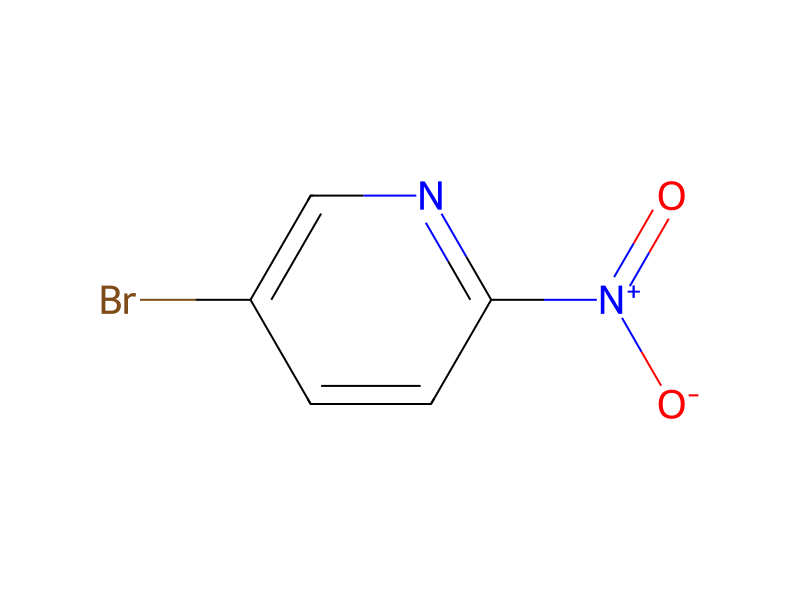
5-Bromo-2-nitropyridine → HCID 67356021, compound
Reaction equation

[C:1]([O:5][C:6]([N:8]1[CH2:18][CH2:17][CH2:16][C:10]2([O:14][C:13](=[O:15])[NH:12][CH2:11]2)[CH2:9]1)=[O:7])([CH3:4])([CH3:3])[CH3:2].Br[C:20]1[CH:21]=[CH:22][C:23]([N+:26]([O-:28])=[O:27])=[N:24][CH:25]=1>>[C:1]([O:5][C:6]([N:8]1[CH2:18][CH2:17][CH2:16][C:10]2([O:14][C:13](=[O:15])[N:12]([C:20]3[CH:25]=[N:24][C:23]([N+:26]([O-:28])=[O:27])=[CH:22][CH:21]=3)[CH2:11]2)[CH2:9]1)=[O:7])([CH3:4])([CH3:2])[CH3:3]Participants
3


Procedure
Following general N—C coupling procedure 1, 2-oxo-1-oxa-3,7-diaza-spiro[4.5]decane-7-carboxylic acid tert-butyl ester (0.546 g, 2.130 mmol) (Reference: German Patent DE10 2005 030051A1 (28 Dec. 2006)), was combined with 5-bromo-2-nitropyridine (0.432 g, 2.130 mmol, 1.0 eq) which gave 3-(6-Nitro-pyridin-3-yl)-2-oxo-1-oxa-3,7-diaza-spiro[4.5]decane-7-carboxylic acid tert-butyl ester as a brown solid (0.709 g, 1.735 mmol) in 81% yield. 1H NMR (400 MHz, CDCl3) δ ppm 1.46 (br. s., 9H) 1.55-1.73 (m, 2H) 1.89-2.17 (m, 3H) 3.41 (br. s., 2H) 3.65 (br. s., 2H) 3.78-3.88 (m, 1H) 3.95 (d, J=8.03 Hz, 1H) 8.34 (d, J=9.03 Hz, 1H) 8.54 (br. s., 1H) 8.61 (dd, J=9.03, 3.01 Hz, 1H) MS m/z 379.1 (M+H)+.
Sources & evidence
- ORD record
- ord-15cf30ea8fe5459f9de1dbcf801a3fd6
- Source dataset
- uspto-grants-2016_04
- Patent number
- US09309252B2
Reaction notes
Loading…