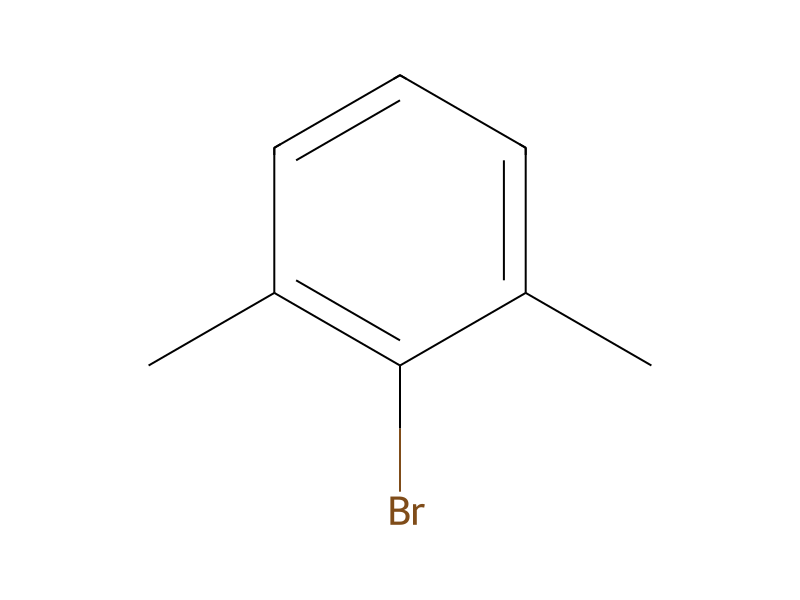
2-Bromo-m-xylene → 1,3,2-Dioxaborolane, 2-(2,6-dimethylphenyl)-4,4,5,5-tetramethyl-
Reaction equation

[CH3:1][C:2]1[CH:7]=[CH:6][CH:5]=[C:4]([CH3:8])[C:3]=1Br.[Li]CCCC.C(O[B:19]1[O:23][C:22]([CH3:25])([CH3:24])[C:21]([CH3:27])([CH3:26])[O:20]1)(C)C>>[CH3:1][C:2]1[CH:7]=[CH:6][CH:5]=[C:4]([CH3:8])[C:3]=1[B:19]1[O:23][C:22]([CH3:25])([CH3:24])[C:21]([CH3:27])([CH3:26])[O:20]1Participants



Procedure
To a solution of 35.0 g (0.19 mol) of 2,6-dimethylbromobenzene cooled to −78° C., 76 ml (0.19 mol) of 2.5 M nBuLi in hexanes was added for 40 min. The resulting mixture was stirred at this temperature for 1 h, then 35.2 g (0.19 mol) of 2-isopropoxy-4,4,5,5-tetramethyl-1,3,2-dioxaborolane was added. The resulting mixture was stirred overnight at room temperature and then evaporated to dryness. The residue was poured into 500 ml of water, crude product was extracted with 3×200 ml of ethyl acetate. The combined organic extract was dried over Na2SO4 and then evaporated to dryness. Yield 19.5 g (53%) of yellow crystalline solid. Anal. calc. for C14H21BO2: C, 72.44; H, 9.12. Found: C, 72.78; H, 9.45. 1H NMR (CDCl3): δ 7.12 (t, J=7.7 Hz, 1H, 4-H), 6.94 (d, J=7.7 Hz, 2H, 3, 5-H), 2.40 (s, 6H, 2, 6-Me), 1.38 (s, 12H, Bpin).
Workup
- stirringThe resulting mixture was stirred overnight at room temperature
- customevaporated to dryness
- additionThe residue was poured into 500 ml of water, crude product
- extractionwas extracted with 3×200 ml of ethyl acetate
- extractionThe combined organic extract
- dry with materialwas dried over Na2SO4
- customevaporated to dryness
Sources & evidence
- ORD record
- ord-2660b9f55cc64a16ab9987e7e7a8c385
- Source dataset
- uspto-grants-2016_04
- Patent number
- US09321858B2
Reaction notes
Loading…