Water → Phenethyl Benzoate
Reaction equation

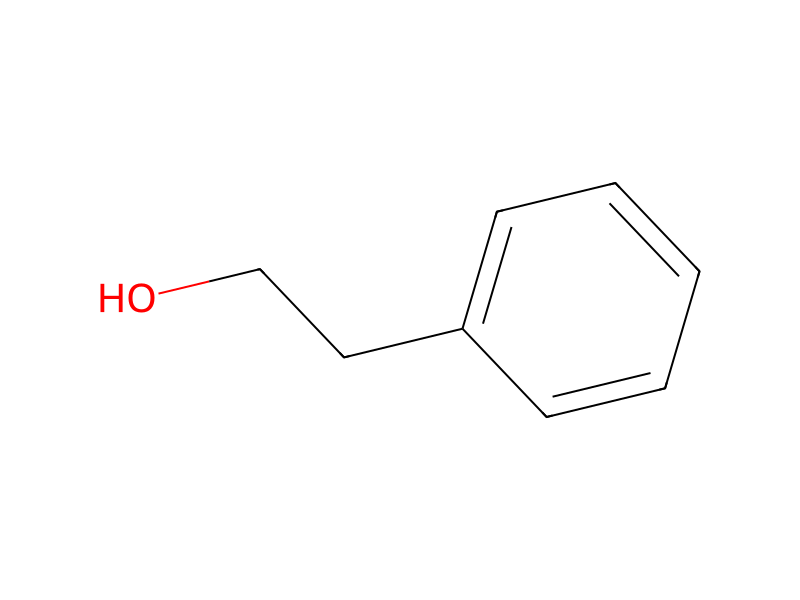
[C:1]1([CH2:7][CH2:8][OH:9])[CH:6]=[CH:5][CH:4]=[CH:3][CH:2]=1.[PH2](O)=O.[OH2:13]>>[C:7]([O:9][CH2:8][CH2:7][C:1]1[CH:6]=[CH:5][CH:4]=[CH:3][CH:2]=1)(=[O:13])[C:1]1[CH:6]=[CH:5][CH:4]=[CH:3][CH:2]=1Participants



Procedure
The reaction was run as described in Example 2 except that the initial excess of 2-phenylethyl alcohol was 10% rather than 20%, and the organic layer that co-distilled with the water of reaction was returned to the batch at the end of each hold but the last one. After 4 h at 180-210° C., the reaction mixture was cooled to room temperature, where the acid number was 5.50 (97.8% conversion), the APHA color was 114, and the excess 2-phenylethyl alcohol was 4.8% by GLC. A 9.94-g aliquot of 50% w/w aqueous hypophosphorous acid (HPA, 0.40% w/w based on H3PO2) was added. The excess 2-phenylethyl alcohol was removed by vacuum distillation as usual. The APHA color was 39 and the residual 2-phenylethyl alcohol was 0.19% by GLC. Treatment with activated carbon as usual afforded 1100 g (88%) of 2-phenylethyl benzoate. The APHA color was 36, the acid number was 2.10 mg KOH/g, the saponification number was 244 mg KOH/g, the residual tin was 270 ppm, and the residual phosphorous was 1300 ppm.
Workup
- customThe excess 2-phenylethyl alcohol was removed by vacuum distillation as usual
Sources & evidence
- ORD record
- ord-ea5e6520b1694a86bed7cdc6af552e69
- Source dataset
- uspto-grants-2010_04
- Patent number
- US07691363B2
Reaction notes
Loading…