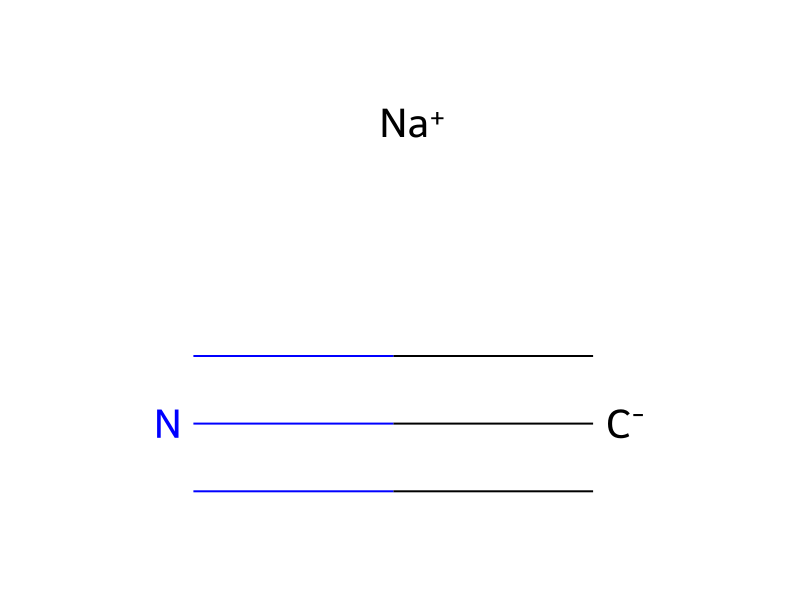
Sodium Cyanide → 2-(4-Chloro-3-trifluoromethyl-phenyl)-ethylamine hydrochloride
Reaction equation

BrCC1C=CC([Cl:9])=C(C(F)(F)F)C=1.[C-]#N.[Na+].[Cl:17][C:18]1[CH:23]=[CH:22][C:21]([CH2:24][C:25]#[N:26])=[CH:20][C:19]=1[C:27]([F:30])([F:29])[F:28]>CS(C)=O>[ClH:9].[Cl:17][C:18]1[CH:23]=[CH:22][C:21]([CH2:24][CH2:25][NH2:26])=[CH:20][C:19]=1[C:27]([F:28])([F:29])[F:30]Participants
5



Conditions
- Temperature
- 50 °C
Procedure
A mixture of 4-bromomethyl-1-chloro-2-trifluoromethyl-benzene (3.94 g, 14.4 mmol) and sodium cyanide (1.06 g, 21.6 mmol) in dimethyl sulfoxide (12 mL) was heated at 50° C. for one hour. The reaction mixture was then poured on ice water and extracted four times with dichloromethane. The combined organic phases were washed with water, dried over magnesium sulfate, filtered and concentrated, leading to (4-chloro-3-trifluoromethyl-phenyl)-acetonitrile (3.19 g, 14.4 mmol) as a dark red oil. This crude material was transformed into the title compound in accordance with the general method of example H2. White solid, MS (ISP) 224.1 (M−Cl)+.
Workup
- additionThe reaction mixture was then poured on ice water
- extractionextracted four times with dichloromethane
- washThe combined organic phases were washed with water
- dry with materialdried over magnesium sulfate
- filtrationfiltered
- concentrationconcentrated
Sources & evidence
- ORD record
- ord-54f84f45b84d4484bbd2c61b7056c7d3
- Source dataset
- uspto-grants-2010_04
- Patent number
- US07691876B2
Reaction notes
Loading…