Benzoyl Peroxide → Ethyl 2-bromo-4-(bromomethyl)thiazole-5-carboxylate
Reaction equation

[CH2:1]([O:3][C:4]([C:6]1[S:10][C:9]([Br:11])=[N:8][C:7]=1[CH3:12])=[O:5])[CH3:2].[Br:13]N1C(=O)CCC1=O.C(OOC(=O)C1C=CC=CC=1)(=O)C1C=CC=CC=1>C1C=CC=CC=1.C(OCC)(=O)C>[CH2:1]([O:3][C:4]([C:6]1[S:10][C:9]([Br:11])=[N:8][C:7]=1[CH2:12][Br:13])=[O:5])[CH3:2]Participants


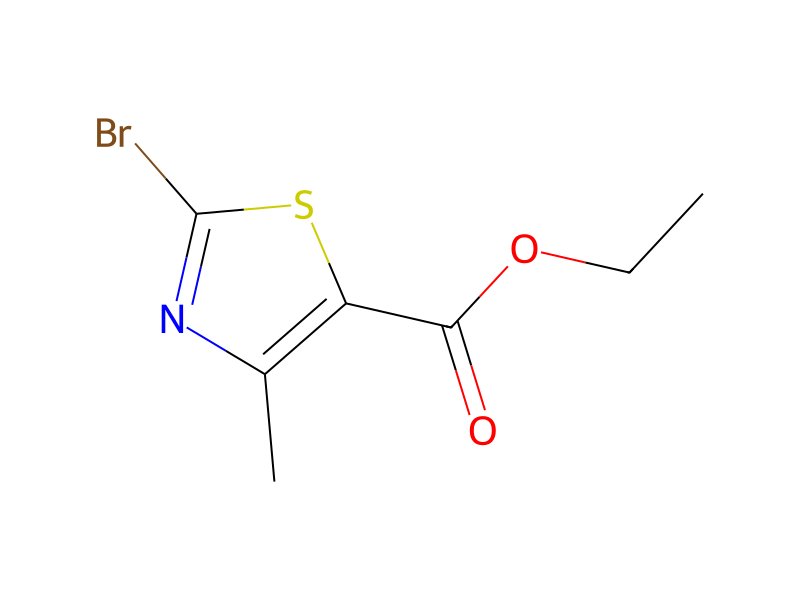



Procedure
2-Bromo-4-methyl-thiazole-5-carboxylic acid ethyl ester (17 g, 68.0 mmol, purchased from Ryan Scientific), N-bromosuccinimide (12.7 g, 71.4 mmol), and benzoyl peroxide (1.65 g, 6.8 mmol) were suspended in 222 mL of benzene and heated at reflux temperature for 16 h. The reaction mixture was cooled and diluted with ethyl acetate. The reaction mixture was washed successively with saturated bicarbonate solution, brine, saturated ammonium chloride solution, and brine. The organic solvent was dried, filtered, and concentrated. The crude product was purified by flash chromatography eluting from silica gel with a gradient of 0-20% ethyl acetate in hexanes to produce 22.1 g of a light yellow solid. 1H NMR (CDCl3, 200 MHz): δ=4.88 (s, 2H), 4.37 (q, 2H, J=7.0 Hz), and 1.39 (t, 3H, J=7.0 Hz).
Workup
- temperatureheated
- temperatureat reflux temperature for 16 h
- temperatureThe reaction mixture was cooled
- washThe reaction mixture was washed successively with saturated bicarbonate solution, brine, saturated ammonium chloride solution, and brine
- customThe organic solvent was dried
- filtrationfiltered
- concentrationconcentrated
- customThe crude product was purified by flash chromatography
- washeluting from silica gel with a gradient of 0-20% ethyl acetate in hexanes
Sources & evidence
- ORD record
- ord-240b28bc52d3429ca4560225be50c024
- Source dataset
- uspto-grants-2010_04
- Patent number
- US07696223B2
Reaction notes
Loading…