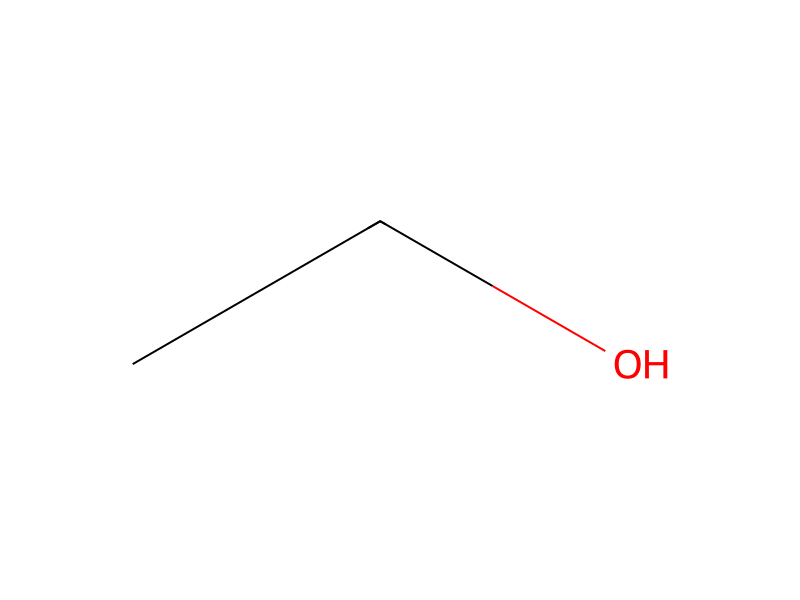
Ethanol → HCID 20141396, compound
Reaction equation

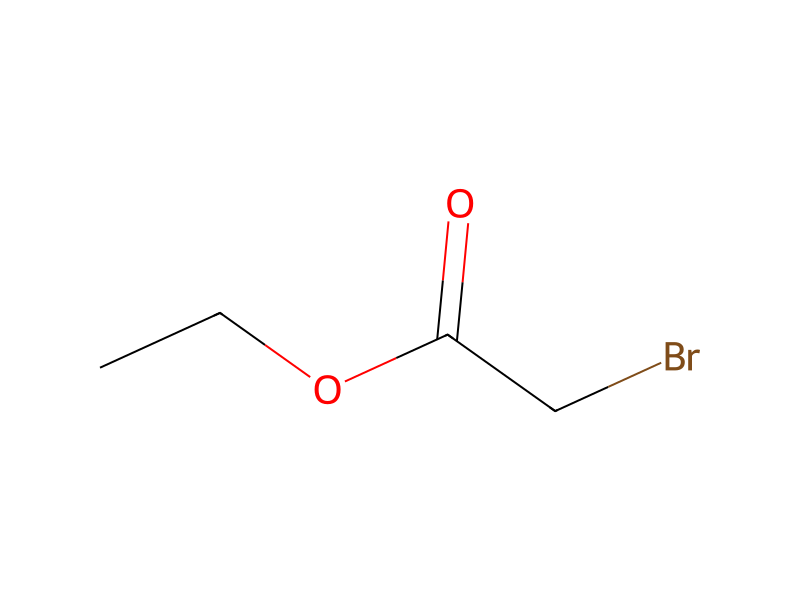
[CH3:1][S:2]([NH:5][CH2:6][CH2:7][NH:8][C:9](=[S:11])[S-:10])(=[O:4])=[O:3].C([NH+](CC)CC)C.[CH2:19]([OH:21])[CH3:20].BrCC(OCC)=O>O>[CH3:1][S:2]([NH:5][CH2:6][CH2:7][N:8]1[C:19](=[O:21])[CH2:20][S:11][C:9]1=[S:10])(=[O:3])=[O:4]Participants
Reactant 3

Product 1

Reagents, catalysts & solvents 1
Conditions
- Temperature
- 20 °C
Procedure
30 g (2.1×10⁻¹ mols) of 2-methanesulfonylaminoethylamine and 18.1 g (2.3×10⁻¹ mols) of carbon bisulfide were dispersed into 10 ml of ethyl acetate. 32.8 g (2.3×10⁻¹ mols) of triethylamine was added dropwise to the dispersion while stirring at room temperature. The admixture was allowed to react for about 4 hours while the internal temperature thereof was maintained at 40° C. 70 ml of ethanol was added to the reaction system. The resulting crystal was filtered off and then washed with 30 ml of ethanol to obtain 54.0 g of triethylammonium N-(2-methanesulfonylaminoethyl)dithiocarbamate as an intermediate product. 54.0 g (1.7×10⁻¹ mols) of the thus-obtained triethylammonium N-(2-methanesulfonylaminoethyl)dithiocarbamate was dispersed into 75 ml of ethanol. The dispersion was stirred while the internal temperature thereof was maintained at 7° to 8° C. under ice cooling. 28.6 g (1.7×10⁻¹ mols) of ethyl bromoacetate was added dropwise to the dispersion. The dispersion was stirred for about 1 hour while the internal temperature was maintained at 20° C. by suppressing heat generation under ice cooling. The dispersion was further stirred for about 1 hour at room temperature. The resulting reaction product was put into 300 ml of water. The aqueous mixture was extracted with 500 ml of ethyl acetate. The mixture was then washed with water. The resulting ethyl acetate layer was dried over anhydrous sodium sulfate. The ethyl acetate solution was filtered, and the filtrate was concentrated to obtain 43.7 g of 3-(2-methanesulfonylaminoethyl)rhodanine (yield: 100%).
Workup
- temperaturethereof was maintained at 7° to 8° C. under ice cooling
- stirringThe dispersion was stirred for about 1 hour while the internal temperature
- temperatureby suppressing heat generation under ice cooling
- stirringThe dispersion was further stirred for about 1 hour at room temperature
- customThe resulting reaction product
- extractionThe aqueous mixture was extracted with 500 ml of ethyl acetate
- washThe mixture was then washed with water
- dry with materialThe resulting ethyl acetate layer was dried over anhydrous sodium sulfate
- filtrationThe ethyl acetate solution was filtered
- concentrationthe filtrate was concentrated
Sources & evidence
- ORD record
- ord-59703d39837f4431af22a2719fed8150
- Source dataset
- uspto-grants-1988_04
- Patent number
- US04740455
Reaction notes
Loading…