L-(+)-Cysteine → L-(+)-Cysteine
Reaction equation

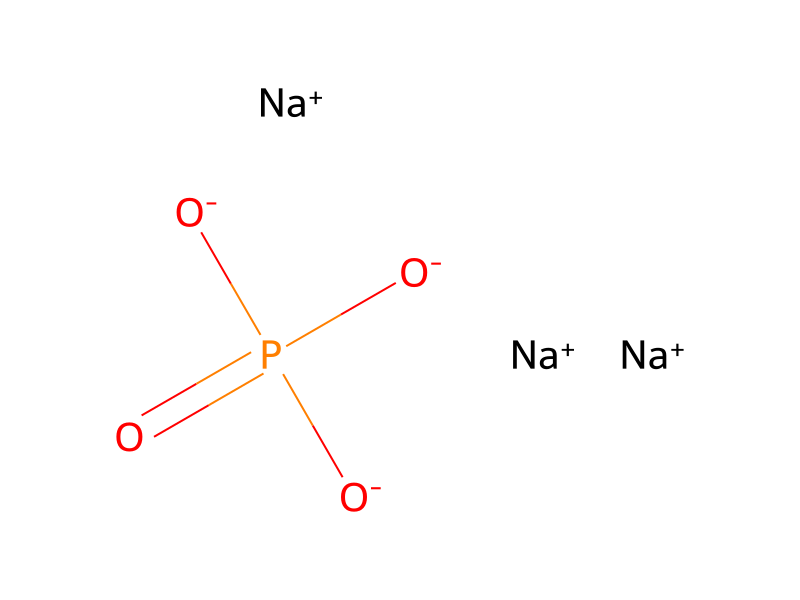
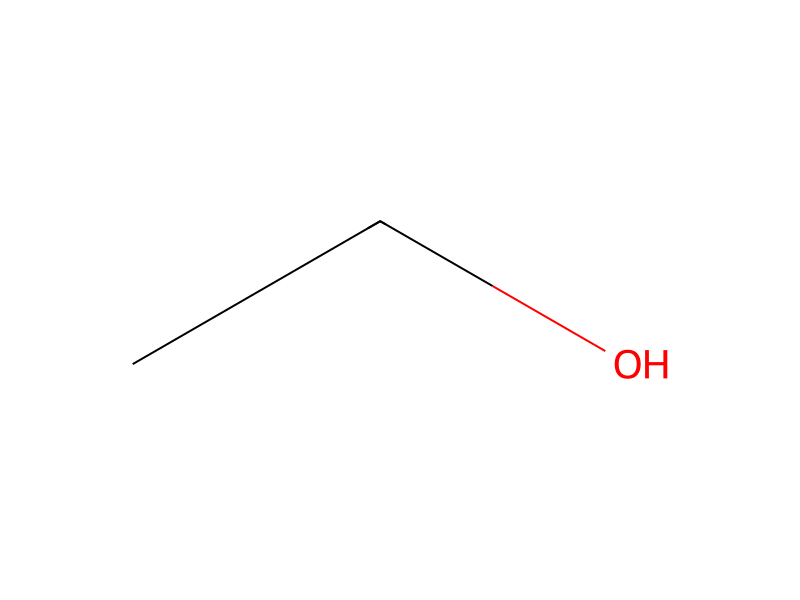
P([O-])([O-])([O-])=O.[Na+].[Na+].[Na+].[NH2:9][C@H:10]([C:13]([OH:15])=[O:14])[CH2:11][SH:12].[CH2:16](O)[CH3:17].C(Cl)(Cl)Cl.C1C=CC=CC=1>C(O)C.Cl.O.[O-][99Tc](=O)(=O)=O.[Na+]>[NH2:9][C@H:10]([C:13]([O:15][CH2:16][CH3:17])=[O:14])[CH2:11][SH:12].[NH2:9][C@H:10]([C:13]([OH:15])=[O:14])[CH2:11][SH:12]Participants
Reactant 3


Product 2

Reagents, catalysts & solvents 4

Conditions
- Temperature
- 80 °C
Procedure
In a mixture of 0.6 ml of ethanol and 0.1 ml (1 mol/l) of an aqueous HCl solution were dissolved 5 mg of SDH and 1.5 mg of PNP, followed by adding thereto a physiologically acceptable 99mTcO4− solution (0.5 ml, 50 MBq). The resulting mixture was heated at 80° C. for 20 minutes and then cooled to room temperature, after which 1 ml of sodium phosphate buffer (0.05 mol/l) was added thereto to adjust the pH to about 7.8. Subsequently, a solution of 3.0 mg of Cys in 0.50 ml of water was added, and the resulting mixture was allowed to stand at room temperature for 30 minutes. The complex finally obtained was analyzed by HTLC and HPLC. FIG. 6 shows a radiochromatogram of the complex which was obtained by development on a silica gel plate with an ethanol/chloroform/benzene (0.85/2/1.5) mixture. The radiochemical purity of the final complex was higher than 90%. The complex contained a Tc≡N group in which a PNP bidentate ligand was coordinated with the metal ion at trans conformation and a dianion Cys was coordinated with the remaining two positions through the sulfur atom which had lost a proton and the nitrogen atom of the amino group which had lost a proton. As a result of the same experiment as above except using an ester derivative (CysOEt), it was found that the carboxyl group of Cys did not participate in the coordination with the metal. CysOEt is formed by the replacement of the OH group of the carboxyl group of Cys by an ethoxy group, and the radiochemical purity of a final complex obtained from the ligand (CysOEt) was higher than 93% (FIG. 7). Solutions of the complexes, respectively, are all stable.
Workup
- dissolutionwere dissolved 5 mg of SDH and 1.5 mg of PNP
- additionby adding
- temperaturecooled to room temperature
- customThe complex finally obtained
- customAs a result of the same experiment as above
Sources & evidence
- ORD record
- ord-06af7e473b864a789254838f94b6cc87
- Source dataset
- uspto-grants-2001_08
- Patent number
- US06270745B1
Reaction notes
Loading…