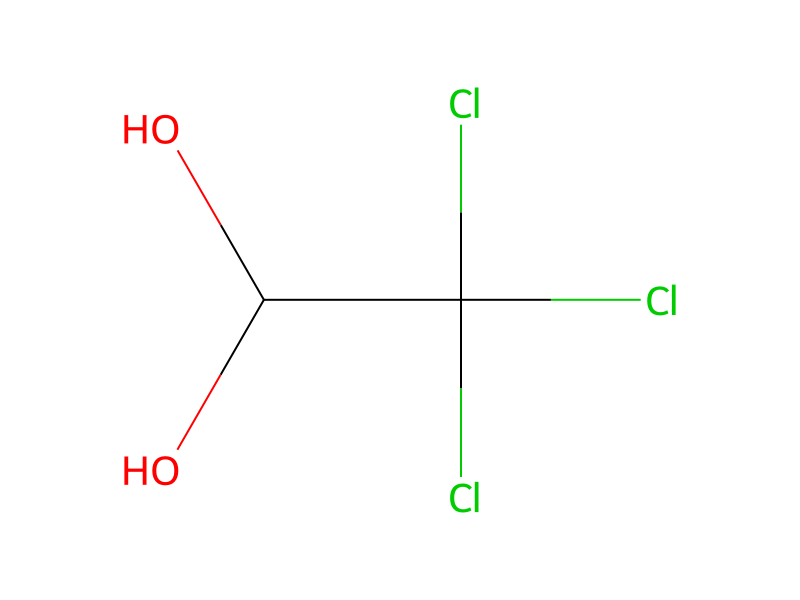
Chloral Hydrate → HCID 57046400, compound
Reaction equation

[Cl:1][C:2]([Cl:7])([Cl:6])[CH:3](O)O.[C:8]1([CH3:19])[CH:13]=[CH:12][C:11]([S:14]([NH:17][NH2:18])(=[O:16])=[O:15])=[CH:10][CH:9]=1>CO>[C:8]1([CH3:19])[CH:9]=[CH:10][C:11]([S:14]([NH:17][N:18]=[CH:3][C:2]([Cl:7])([Cl:6])[Cl:1])(=[O:15])=[O:16])=[CH:12][CH:13]=1Participants
Reactant 2

Product 1

Reagents, catalysts & solvents 1

Procedure
In 20 ml of methanol were dissolved 0.91 g (5.5 mmole) of chloral hydrate and 0.93 g (5 mmole) of p-toluenesulfonylhydrazine, and the mixture was stirred at room temperature for 30 minutes to form trichloroacetaldehyde-p-toluenesulfonylhydrazone. Then, a solution of 3.96 g (16.5 mmole) of sodium sulfide nonahydrate dissolved in 20 ml of water was added little by little to the aforesaid solution of the hydrazone under room temperature while maintaining the pH within 10 to 11. After about 60 minutes, about 2/3 amount of the sodium sulfide solution was added thereto and the pH of the reaction mixture remained at 11.2 or less. At this time, the reaction mixture was analyzed by sampling a part thereof, a yield of sodium salt of 5-mercapto-1,2,3-thiadiazole of 40% was obtained referred to the starting p-toluenesulfonylhydrazine. Thereafter, the remainder of the sodium sulfide solution was added thereto for about 30 minutes, the ultimate pH of the solution was 12.3 and the yield of sodium salt of 5-mercapto-1,2,3-thiadiazole was 46%.
Sources & evidence
- ORD record
- ord-fc9cbfee6cfe46d8a1f9cec5884ea705
- Source dataset
- uspto-grants-1987_06
- Patent number
- US04675412
Reaction notes
Loading…