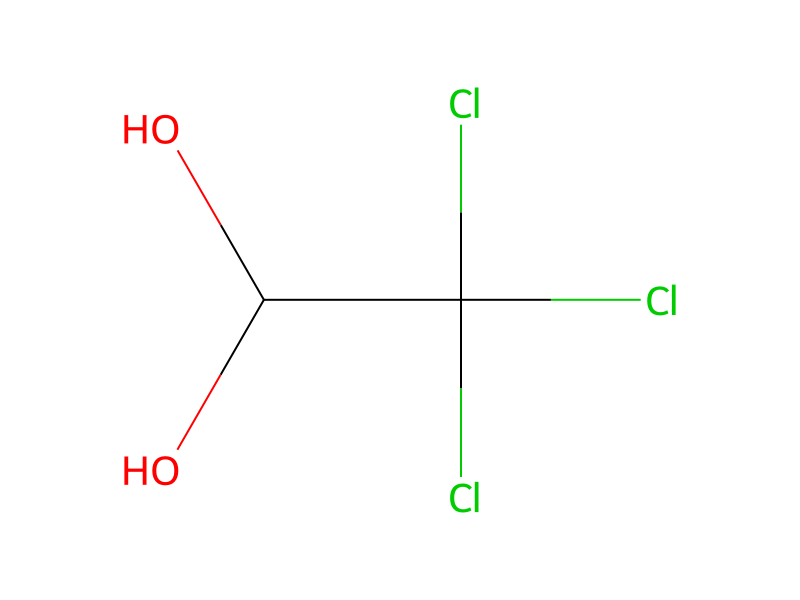
Chloral Hydrate → HCID 57046400, compound
Reaction equation

[Cl:1][C:2]([Cl:7])([Cl:6])[CH:3](O)O.[C:8]1([CH3:19])[CH:13]=[CH:12][C:11]([S:14]([NH:17][NH2:18])(=[O:16])=[O:15])=[CH:10][CH:9]=1>CO>[C:8]1([CH3:19])[CH:9]=[CH:10][C:11]([S:14]([NH:17][N:18]=[CH:3][C:2]([Cl:7])([Cl:6])[Cl:1])(=[O:15])=[O:16])=[CH:12][CH:13]=1Participants
Reactant 2

Product 1

Reagents, catalysts & solvents 1

Procedure
In 20 ml of methanol were dissolved 0.99 g (6 mmole) of chloral hydrate and 0.93 g (5 mmole) of p-toluenesulfonylhydrazine, and the mixture was stirred at room temperature for 30 minutes to form trichloroacetaldehyde-p-toluenesulfonylhydrazone. Then, to the reaction mixture was added under room temperature 15 ml of a 30% hydrated methanol solution containing 1.7 g (25 mmole) of ammonium sulfide for 10 minutes. Thereafter, the reaction was continued for further 2 hours while maintaining the pH of the reaction system at 10.4 by using 28% aqueous ammonia, a 30% aqueous potassium hydroxide solution, etc. The analysis after completion of the reaction was carried out in the same manner as in Example 1. The yield of the 5-mercapto-1,2,3-thiadiazole salt referred to the starting p-toluenesulfonylhydrazine was 22%.
Sources & evidence
- ORD record
- ord-89cd5cb4791d410690fde0516fabe6d8
- Source dataset
- uspto-grants-1987_06
- Patent number
- US04675412
Reaction notes
Loading…