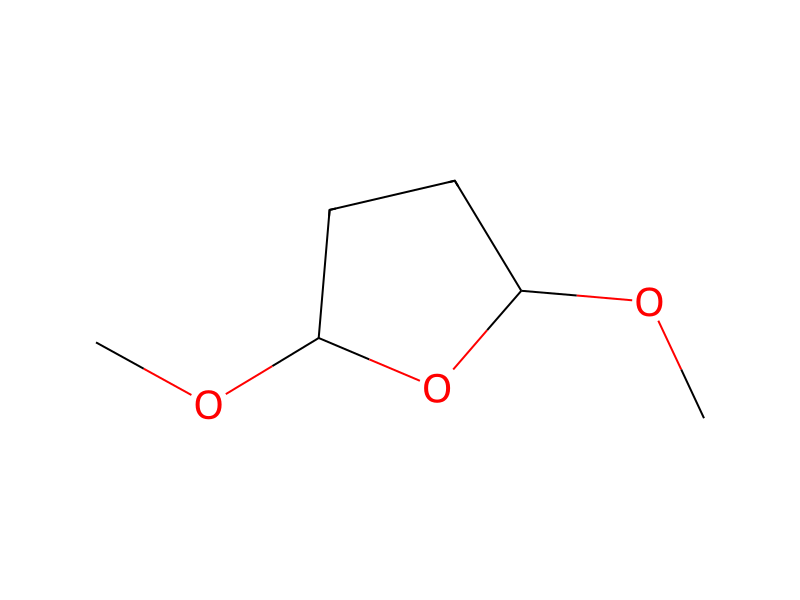
2,5-Dimethoxytetrahydrofuran → methvl 2-(aminosulfonyl)4-(1H-pyrrol-1-yl)benzoate
Reaction equation

[NH2:1][C:2]1[CH:11]=[CH:10][C:5]([C:6]([O:8][CH3:9])=[O:7])=[C:4]([S:12]([NH2:15])(=[O:14])=[O:13])[CH:3]=1.CO[CH:18]1[CH2:22][CH2:21][CH:20](OC)O1>C(O)(=O)C>[NH2:15][S:12]([C:4]1[CH:3]=[C:2]([N:1]2[CH:18]=[CH:22][CH:21]=[CH:20]2)[CH:11]=[CH:10][C:5]=1[C:6]([O:8][CH3:9])=[O:7])(=[O:13])=[O:14]Participants
4
Reactant 2

Product 1

Reagents, catalysts & solvents 1

Conditions
- Temperature
- 110 °C
Procedure
In 3 ml of acetic acid, 300 mg (1.3 mmol) of methyl 4-amino2-(aminosulfonyl)benzoate and 0.23 ml of 2,5-dimethoxytetrahydrofuran were dissolved, followed by stirring at 110° C. for 1.5 hours. Acetic acid was then distilled off, followe by the addition of 30 ml of ice water. After the mixture thus obtained wa stirred for 20 minutes, the resulting precipitate was collected by filtration and dried in air. The brown solid thus obtained was purified b column chromatography, using silica gel ("Wako Gel C300", trade name; product of Wako Pure Chemical Industries, Ltd.) and dichloromethane, thereby obtaining the title compound as a white solid. Yield: 175.7 mg (48%). Its physicochemical properties are shown in Table 7.
Workup
- distillationAcetic acid was then distilled off
- additionfollowe by the addition of 30 ml of ice water
- customAfter the mixture thus obtained
- stirringwa stirred for 20 minutes
- filtrationthe resulting precipitate was collected by filtration
- customdried in air
- customThe brown solid thus obtained
- customwas purified b column chromatography
Sources & evidence
- ORD record
- ord-f5f965144e944d85a524a865661d8b46
- Source dataset
- uspto-grants-1992_07
- Patent number
- US05127937
Reaction notes
Loading…