Sodium Hydroxide → 6-Chloro-2-fluoropurine
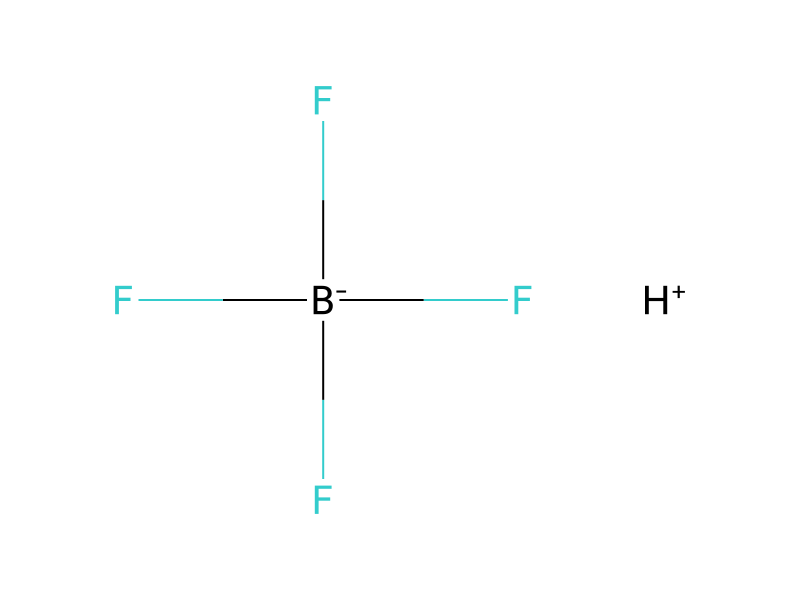
Reaction equation

N[C:2]1[N:10]=[C:9]2[C:5]([NH:6][CH:7]=[N:8]2)=[C:4]([Cl:11])[N:3]=1.[F:12][B-](F)(F)F.[H+].N([O-])=O.[Na+].[OH-].[Na+]>O>[F:12][C:2]1[N:10]=[C:9]2[C:5]([NH:6][CH:7]=[N:8]2)=[C:4]([Cl:11])[N:3]=1Participants
Reactant 4



Product 1

Reagents, catalysts & solvents 1

Procedure
To 2-amino-6-chloropurine (5.0 g, 29.5 mmol) in a solution of tetrafluoroboric acid in water (100 mL) at −15° C. was added dropwise sodium nitrite (3.5 g, 50 mmol) in water (160 mL) over a period of 1.5 h. After 20 min at room temperature, the pH of the solution was adjusted to 6 with 50% aqueous sodium hydroxide. The solution was concentrated under reduced pressure. The crude residue was purified on a BIOTAGE™ 40S column (silica, CH2Cl2/MeOH 9:1) to give 2-fluoro-6-chloropurine (2.3 g, 52%). This compound (1.5 g, 8.6 mmol) was suspended in dry tetrahydrofuran (20 mL) at 25° C. The 4-(N-1-tert-butyloxycarbonyl)-aminophenethyl alcohol (3.4 g, 14.5 mmol) and triphenylphosphine (3.8 g, 14.5 mmol) were then added, and the mixture evaporated to dryness. Dry tetrahydrofuran (20 mL) was added and the suspension was cooled to 0° C. before dropwise addition of diethylazodicarboxylate (1.5 mL, 9.8 mmol). After 16 h reaction at room temperature, the solution was concentrated under reduced pressure. The crude residue was purified on a BIOTAGE™ 25M column (silica, hexane/AcOEt 95:5 to 75:25) to yield N-9 alkylated purine as a white solid (2.9 g, 87%). To a solution of alkylated 2-fluoro-6-chloropurine (3.0 g, 7.7 mmol) in n-butanol (15 mL) at 25° C. was added N-1-tert-butyloxycarbonyl-1,3-phenylenediamine (1.8 g, 8.8 mmol) and diisopropylethylamine (2.7 mL, 15.3 mmol). After 48 h reaction at 65° C., the brown solution was concentrated under reduced pressure. The crude residue was purified on a BIOTAGE™ 40M column (silica, hexane/AcOEt 65:45 to 0:1) to yield the fluoropurine derivative as a brown solid (2.8 g, 63%). To a solution of this product (2.8 g, 4.9 mmol) in n-butanol (15 mL) at room temperature was added aminomethylcyclopropane (1.2 g, 17.1 mmol) and diisopropylethylamine (1.7 mL, 9.8 mmol). After 48 h reaction at 110° C., the brown solution was concentrated under reduced pressure. The crude residue was purified on a BIOTAGE™ 40M column (silica, hexane/AcOEt 60:40 to AcOEt/MeOH 98:2) to yield the protected trisubstituted purine as a white solid (2.3 g, 73%). To a solution of this compound (2.08 g, 3.38 mmol) in dichloromethane (10 mL) at room temperature was added 4N HCl in dioxane (10 mL). The reaction was stirred for 5 h at 25° C. and the solution was concentrated under reduced pressure. The solid was then dried for 16 h under vacuum to yield compound 3 as a brown solid. Yield of product: 1.4 g (quantitative); Rf=0.1 (CH2Cl2/MeOH 98:2); 1H NMR (400 MHz, CD3OD): δ 8.24 (s, 1H), 8.20-7.60 (m, 2H), 7.60-7.00 (m, 6H), 4.56 (t, 2H, J=7.0 Hz), 3.40-3.20 (m, 4H), 1.25-1.15 (m, 1H), 0.60-0.50 (m, 2H), 0.40-0.20 (m, 2H); LRMS (ESI): m/z 415 (MH+), 437 (M+Na); HPLC (method 2): 1.6 min.
Workup
- concentrationThe solution was concentrated under reduced pressure
- customThe crude residue was purified on a BIOTAGE™ 40S column (silica, CH2Cl2/MeOH 9:1)
Sources & evidence
- ORD record
- ord-dc307981db034861b12ca105327bbd5c
- Source dataset
- uspto-grants-2011_12
- Patent number
- US08080555B2
Reaction notes
Loading…