21H,22H-Porphine → HCID 178419803, compound
Reaction equation

[C:1]12[CH:24]=[C:22]3[N:23]=[C:19]([CH:20]=[CH:21]3)[CH:18]=[C:16]3[NH:17][C:13]([CH:14]=[CH:15]3)=[CH:12][C:10]3=[N:11][C:7]([CH:8]=[CH:9]3)=[CH:6][C:4]([NH:5]1)=[CH:3][CH:2]=2.[Zn:25](OC(C)=O)OC(C)=O.O.O>C(Cl)(Cl)Cl.CO>[C:1]12[CH:24]=[C:22]3[N:23]=[C:19]([CH:20]=[CH:21]3)[CH:18]=[C:16]3[NH:17][C:13]([CH:14]=[CH:15]3)=[CH:12][C:10]3=[N:11][C:7]([CH:8]=[CH:9]3)=[CH:6][C:4]([NH:5]1)=[CH:3][CH:2]=2.[Zn:25]Participants
Reactant 2
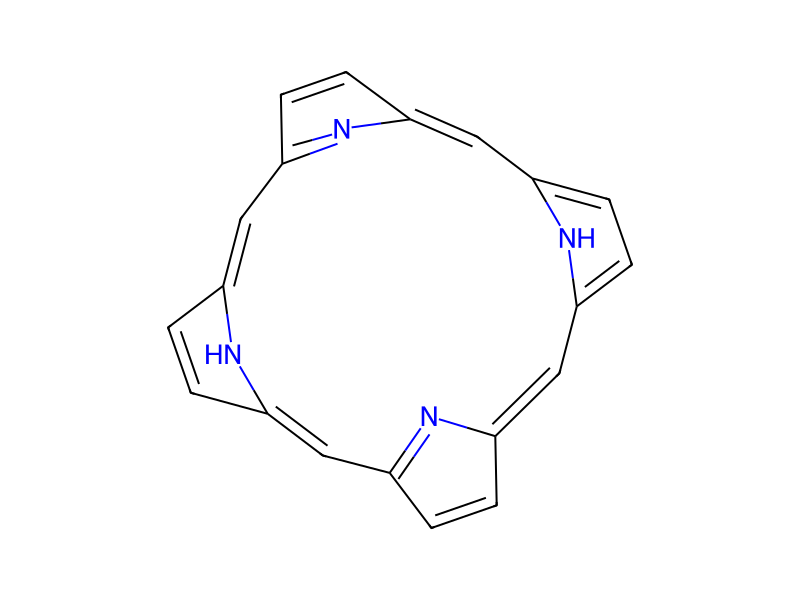

Product 1

Reagents, catalysts & solvents 1

Procedure
Synthesis. A sample of 4-bromobenzaldehyde dimethylacetal46 was coupled with di-tert-butylphosphite to give 4-(di-tert-butyloxyphosphoryl)benzaldehyde dimethylacetal. The latter was used in a mixed-aldehyde condensation47 with pyrrole under standard conditions of BF3.O(Et)2-ethanol cocatalysis48 followed by oxidation with DDQ to give porphyrin 1. Porphyrin 1 was metalated with Zn(OAc)2.2H2O in CHCl3/methanol to afford zinc porphyrin Zn1 in 73% yield (Scheme 1). Cleavage of the tert-butyl groups was achieved by following the known procedure45 with TMS-Cl/TEA in refluxing CHCl3 (stabilized with amylenes). In this manner, the porphyrin Zn2 was obtained without demetalation in 89% yield. Note that CHCl3 stabilized with amylenes rather than ethanol was used to avoid the possible reaction of ethanol with TMS-Cl.
Sources & evidence
- ORD record
- ord-5078377d4175413ab94058d0bc6959ea
- Source dataset
- uspto-grants-2011_12
- Patent number
- US08080653B2
Reaction notes
Loading…