Potassium Hydroxide → HCID 178516434, compound
Reaction equation
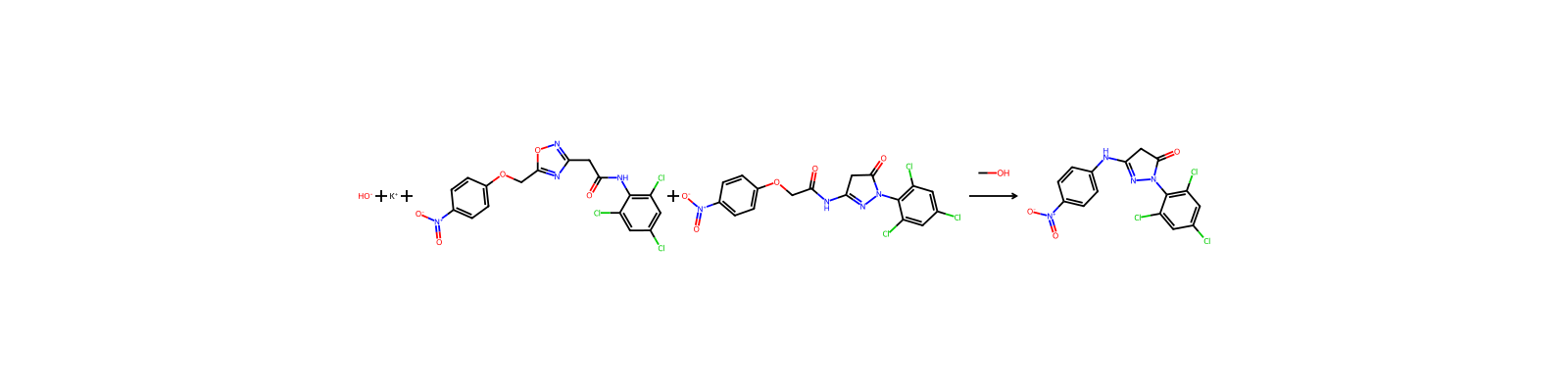
[OH-].[K+].[N+](C1C=CC(O[CH2:11][C:12]2O[N:15]=[C:14]([CH2:17][C:18]([NH:20][C:21]3[C:26]([Cl:27])=[CH:25][C:24]([Cl:28])=[CH:23][C:22]=3[Cl:29])=[O:19])[N:13]=2)=CC=1)([O-])=O.[N+:32]([C:35]1[CH:60]=CC(OCC(NC2CC(=O)N(C3C(Cl)=CC(Cl)=CC=3Cl)N=2)=O)=[CH:37][CH:36]=1)([O-:34])=[O:33]>CO>[N+:32]([C:35]1[CH:60]=[CH:11][C:12]([NH:13][C:14]2[CH2:17][C:18](=[O:19])[N:20]([C:21]3[C:22]([Cl:29])=[CH:23][C:24]([Cl:28])=[CH:25][C:26]=3[Cl:27])[N:15]=2)=[CH:37][CH:36]=1)([O-:34])=[O:33]Participants




Procedure
To a solution of 5 g of potassium hydroxide in 75 ml of anhydrous methanol was added 10 g of 2-[5-(p-nitrophenoxymethyl)-1,2,4-oxadiazol-3-yl]-2',4',6'-trichloroacetanilide. The mixture was heated under reflux for 2 hours. The reaction did not stop with 3-[(p-nitro-phenoxy)acetamido]-1-(2,4,6-trichlorophenyl)-2-pyrazolin-5-one but proceeded further (Smiles rearrangement) to give 3-(p-nitroanilino)-1-(2,4,6-trichlorophenyl)-2-pyrazolin-5-one. At the end of the reaction, the mixture was allowed to cool to room temperature, acidified with 10 ml of acetic acid, diluted with 70 ml of water, and then allowed to stand at room temperature overnight. The product was collected, washed with water and ethanol, and dried. There was obtained 3.8 g (43%) of 3-(p-nitroanilino)-1-(2,4,6-trichlorophenyl)-2-pyrazolin-5-one as yellow crystals, mp 295°-298° C.
Workup
- temperatureThe mixture was heated
- temperatureunder reflux for 2 hours
Sources & evidence
- ORD record
- ord-e8bdf36b797948ebaa1b501bcf0d836c
- Source dataset
- uspto-grants-1982_08
- Patent number
- US04345085
Reaction notes
Loading…