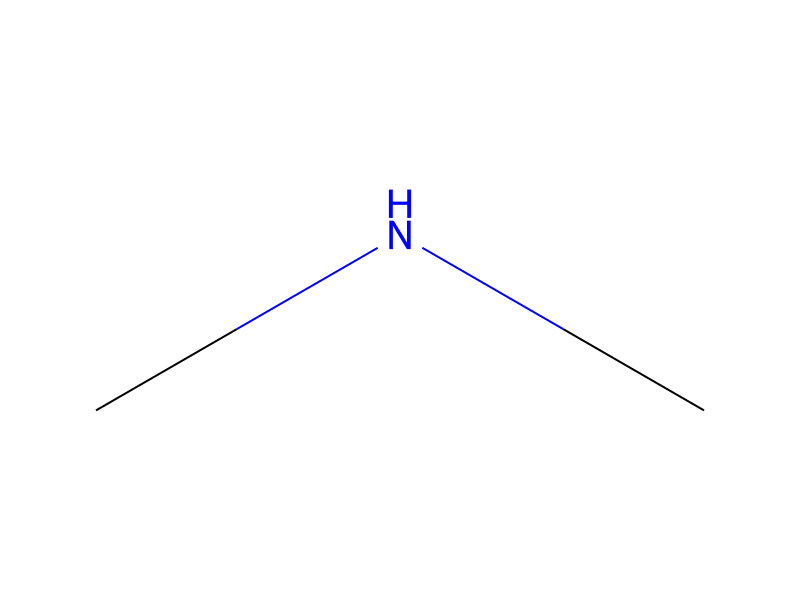
Dimethylamine → Metibride
Reaction equation

Br.[Cl:2][C:3]1[CH:8]=[CH:7][C:6]([C:9]2[N:10]([CH3:21])[C:11](=[N:14][C:15]3[CH:20]=[CH:19][CH:18]=[CH:17][CH:16]=3)[S:12][CH:13]=2)=[CH:5][C:4]=1[S:22](Cl)(=[O:24])=[O:23].[CH3:26][NH:27][CH3:28].CO>C(O)C>[Cl:2][C:3]1[CH:8]=[CH:7][C:6]([C:9]2[N:10]([CH3:21])[C:11](=[N:14][C:15]3[CH:20]=[CH:19][CH:18]=[CH:17][CH:16]=3)[S:12][CH:13]=2)=[CH:5][C:4]=1[S:22](=[O:24])(=[O:23])[N:27]([CH3:28])[CH3:26]Participants
5
Reactant 3


Product 1

Reagents, catalysts & solvents 1

Procedure
4.8 g (0.01 mole) of 4-(4-chloro-3-chlorosulfonylphenyl)-3-methyl-2-phenylimino-4-thiazoline hydrobromide are added in portions to a mixture of 5 ml (about 0.05 mole) of 40% strength aqueous dimethylamine solution and 50 ml of methanol (or ethanol), with external cooling and stirring, at a rate such that the temperature as far as possible does not rise above 35° C. The reaction mixture is stirred for 14 hours at room temperature, the solvent is distilled off under a waterpump vacuum and the residue is crystallized under 50 ml of water, stirring with a magnetic stirrer. Colorless crystals; melting point 178°-181° C.
Workup
- temperaturewith external cooling
- customas possible does not rise above 35° C
- stirringThe reaction mixture is stirred for 14 hours at room temperature
- distillationthe solvent is distilled off under a waterpump vacuum
- customthe residue is crystallized under 50 ml of water
- stirringstirring with a magnetic stirrer
Sources & evidence
- ORD record
- ord-62dda4ab69944a608947378d9c4e1016
- Source dataset
- uspto-grants-1982_08
- Patent number
- US04346088
Reaction notes
Loading…