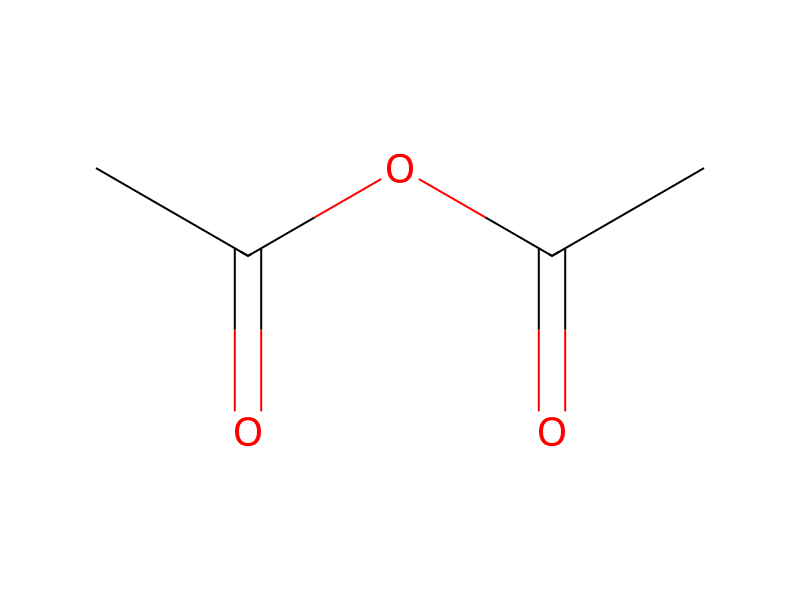
Acetic Anhydride → 1-Acetoxy-1-methyl-silacyclobutane
Reaction equation

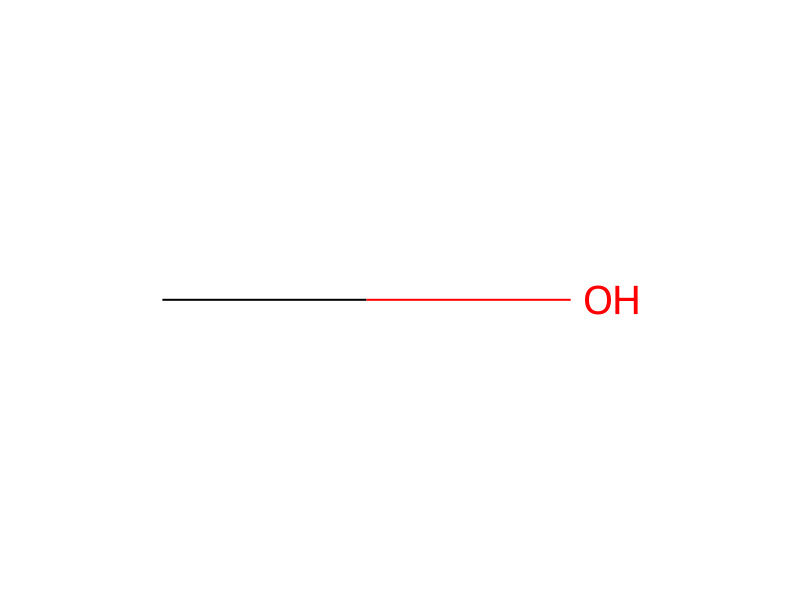
Cl[Si]1(Cl)CCC1.Cl[Si:8]1([CH3:12])[CH2:11][CH2:10][CH2:9]1.[C:13]([O:16]C(=O)C)(=[O:15])[CH3:14]>CO>[C:13]([O:16][Si:8]1([CH3:12])[CH2:11][CH2:10][CH2:9]1)(=[O:15])[CH3:14]Participants
Reactant 3


Product 1

Reagents, catalysts & solvents 1
Procedure
Several silacyclobutane monomers are known. For example, see U.S. Pat. No. 3,046,291 to Leo H. Sommer, and U.S. Pat. No. 3,687,995 to David Jonas et al. Sommer prepared his silacyclobutanes by reacting ClCH2CHRCH2SiR'Cl2 with magnesium. Jonas et al. teach organosilicon compounds having the general formula ##STR4## where R represents an atom or radical selected from the group consisting of hydrogen atom and alkyl radicals having less than 7 carbon atoms and R' represents alkoxy radicals having less than 5 carbon atoms or a radical of the formula --NR"2, in which each R" is a hydrogen atom or an alkyl radical. In U.S. Pat. No. 3,694,427, issued Sept. 26, 1972, Jonas et al. teach that R' can also be acyloxy radical. As an example, the reaction of 1,1-dichlorosilacyclobutane with methylorthoformate gave 1,1-dimethoxysilacyclobutane ##STR5## in 78% yield. Further, the same compound was prepared in only 59% yield by reaction of 1,1-dichlorosilacyclobutane and methanol (Bush, R. Ph.D. Thesis, Univ. of California at Davis, 1975; Diss. Abstr. Int. B 1976, 36, 5034). Similarly, the reaction of 1-chloro-1-methyl-silacyclobutane and acetic anhydride gave 1-acetoxy-1-methyl-silacyclobutane ##STR6## in 48% yield (Nametkin, N. S.; Vdovin, V. M.; Grinberg, P. L. Dokl. Akad. Nauk SSSR, 1964, 155, 849 [320]) Silacyclobutane silazanes have been prepared by metathesis reaction with formation of alkali metal salt or condensation reaction with formation of HCl (Nametkin, N. S.; Vdovin, V. M.; Babich, E. D.; Oppengeim, V. D. Khim. Geterotsikl. Soedin., 1965, 455) and British Patent No. 1,328,514 to Bush et al. These reactions generally give less than quantitative yields and require additional processing steps in comparison to the invention process. The invention process also provides novel compounds. See also Nametkin, N. S.; Vdovin, J. M.; Babich, E. D. Khim. Geterotsikl. Soedin., 1967, 148. Transsilylation of silazanes is taught and transsilylation of 1-chloro-1-methylsilacyclobutane with disilazanes is shown.
Sources & evidence
- ORD record
- ord-e1e81fbc0d874a718bdb01ac6716414e
- Source dataset
- uspto-grants-1991_01
- Patent number
- US04985565
Reaction notes
Loading…