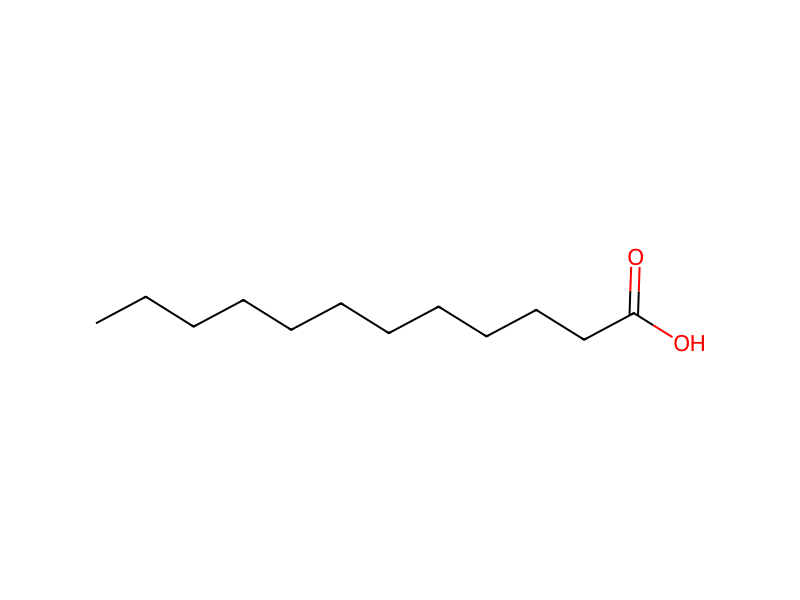
Lauric Acid → Propyl laurate
Reaction equation

O[C:2]1[C:11]2C(=C(C(F)(F)F)C=CC=2)N=C(C(O)CC)[C:3]=1C(NC1SC=CN=1)=O.[C:28]([OH:41])(=[O:40])[CH2:29][CH2:30][CH2:31][CH2:32][CH2:33][CH2:34][CH2:35][CH2:36][CH2:37][CH2:38][CH3:39]>>[C:28]([O:41][CH2:3][CH2:2][CH3:11])(=[O:40])[CH2:29][CH2:30][CH2:31][CH2:32][CH2:33][CH2:34][CH2:35][CH2:36][CH2:37][CH2:38][CH3:39]Participants
3


Procedure
Using the procedure of Example 15, 5 g of 4-hydroxy-2(1-hydroxypropyl)-N-(2-thiazolyl)-8-trifluoromethyl-3-quinoline carboxamide and 2.8 g of lauric acid were reacted to obtain 6 g of 1-[4-hydroxy-3-(2-thiazolylamino)-carbonyl]-8-(trifluoromethyl)-2quinolinyl]-propyl dodecanoate melting at 158° C.
Workup
- customwere reacted
Sources & evidence
- ORD record
- ord-d95ca0b27a8f4bbeaef2d8429a2553e8
- Source dataset
- uspto-grants-1991_01
- Patent number
- US04988708
Reaction notes
Loading…