Potassium Iodide → 3-(3-(1,3-Dioxoisoindolin-2-yl)propoxy)benzaldehyde
Reaction equation

Br[CH2:2][CH2:3][CH2:4][N:5]1[C:9](=[O:10])[C:8]2=[CH:11][CH:12]=[CH:13][CH:14]=[C:7]2[C:6]1=[O:15].[C:16](=[O:19])([O-])[O-].[K+].[K+].[I-].[K+]>C(#N)C>[CH:9]([C:8]1[CH:11]=[C:16]([CH:13]=[CH:14][CH:7]=1)[O:19][CH2:2][CH2:3][CH2:4][N:5]1[C:9](=[O:10])[C:8]2=[CH:11][CH:12]=[CH:13][CH:14]=[C:7]2[C:6]1=[O:15])=[O:10]Participants
5
Reactant 3


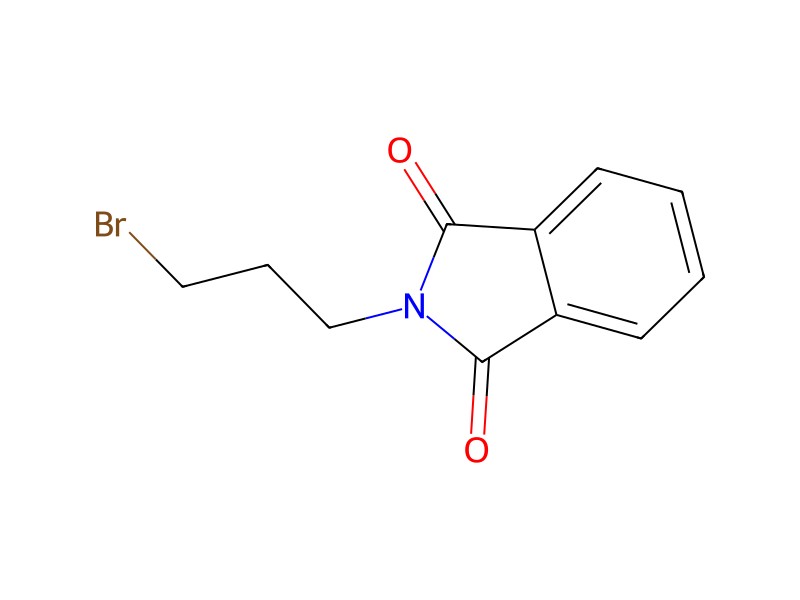
Product 1

Reagents, catalysts & solvents 1

Procedure
m-Hydroxybenzaldehyde (12.2 g), N-(3-bromopropyl)phthalimide (26.8 g), anhydrous potassium carbonate (13.8 g) and potassium iodide (1.7 g) were suspended in acetonitrile (600 ml), and the suspension was heated under reflux for 18 hours. After cooling, the precipitate was removed, and the solvent was evaporated under reduced pressure. The residue was distributed between benzene and water. The organic layer was washed successively with a 1N aqueous NaOH solution, water and a saturated aqueous solution of sodium chloride, and dried over anhydrous magnesium sulfate. The solvent was evaporated under reduced pressure to give 29.16 g (yield 94%) of N-[3-(3-formylphenoxy)propyl]phthalimide as crystals.
Workup
- temperaturethe suspension was heated
- temperatureunder reflux for 18 hours
- temperatureAfter cooling
- customthe precipitate was removed
- customthe solvent was evaporated under reduced pressure
- washThe organic layer was washed successively with a 1N aqueous NaOH solution, water
- dry with materiala saturated aqueous solution of sodium chloride, and dried over anhydrous magnesium sulfate
- customThe solvent was evaporated under reduced pressure
Sources & evidence
- ORD record
- ord-4e880a59fd544db1ae90e99ed59755dd
- Source dataset
- uspto-grants-1991_01
- Patent number
- US04988828
Reaction notes
Loading…