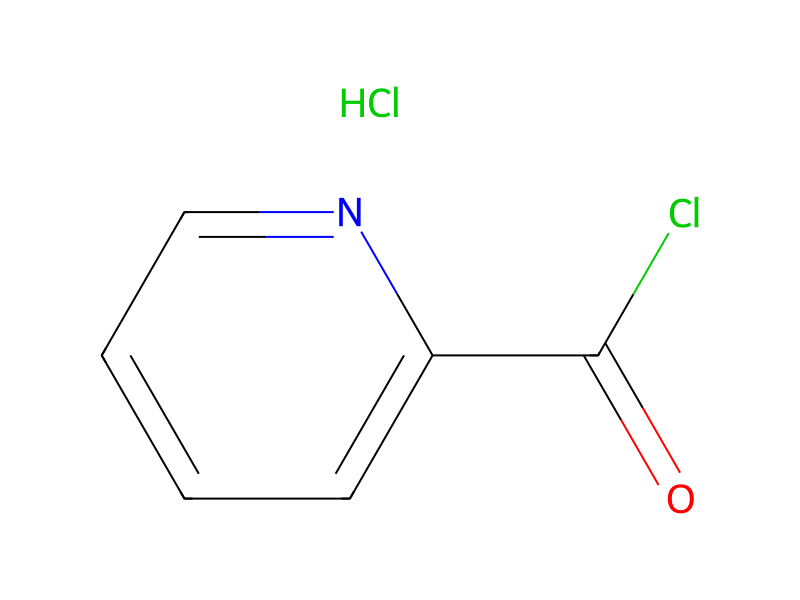
Picolinoyl Chloride Hydrochloride → N-(5-Bromo-4-(trifluoromethyl)thiazol-2-yl)picolinamide
Reaction equation

[Br:1][C:2]1[S:6][C:5]([NH2:7])=[N:4][C:3]=1[C:8]([F:11])([F:10])[F:9].Cl.[N:13]1[CH:18]=[CH:17][CH:16]=[CH:15][C:14]=1[C:19](Cl)=[O:20]>C(Cl)Cl>[Br:1][C:2]1[S:6][C:5]([NH:7][C:19](=[O:20])[C:14]2[CH:15]=[CH:16][CH:17]=[CH:18][N:13]=2)=[N:4][C:3]=1[C:8]([F:11])([F:10])[F:9]Participants
4



Procedure
To a stirred solution of 5-bromo-4-(trifluoromethyl)thiazol-2-amine (0.204 g, 0.826 mmol) ethyldiisopropylamine (0.36 mL, 2.1 mmol) in methylene chloride (4 mL) at 0° C. was added picolinoyl chloride hydrochloride (0.162 g, 0.908 mmol) and the reaction mixture was stirred at room temperature for 15 h. The reaction mixture was diluted with methylene chloride and washed with saturated NaHCO3, dried, filtered and concentrated under vacuum to give the crude product. The residue was purified by column chromatography eluting with ethyl acetate/hexanes 0 to 30% to give the product.
Workup
- washwashed with saturated NaHCO3
- customdried
- filtrationfiltered
- concentrationconcentrated under vacuum
Sources & evidence
- ORD record
- ord-c2f87ae475744f28b6b9d3053afc284e
- Source dataset
- uspto-grants-2015_11
- Patent number
- US09192603B2
Reaction notes
Loading…