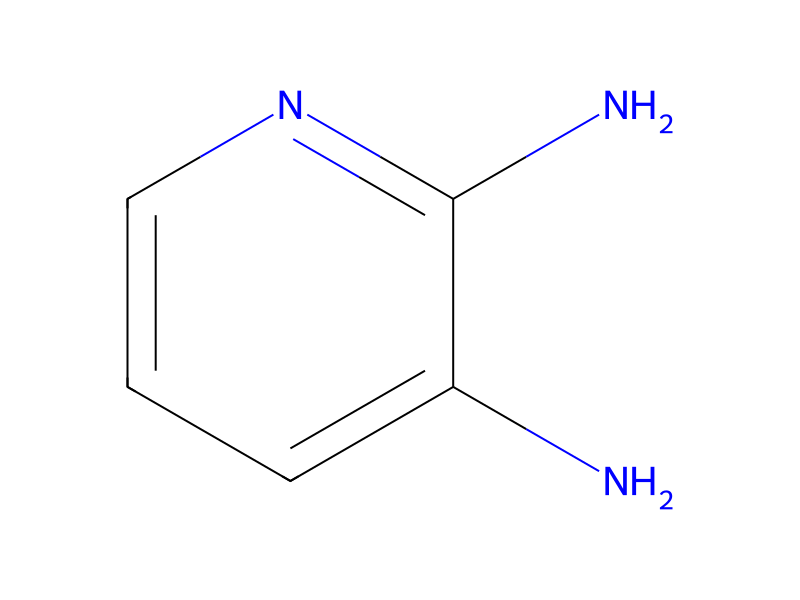
2,3-Diaminopyridine → HCID 178493174, compound
Reaction equation

[CH3:1][O:2][C:3]1[CH:8]=[CH:7][N:6]=[C:5]([CH2:9][CH2:10][C:11](OC)=O)[CH:4]=1.[NH2:15][C:16]1[C:21]([NH2:22])=[CH:20][CH:19]=[CH:18][N:17]=1.[OH-].[Na+]>>[CH3:1][O:2][C:3]1[CH:8]=[CH:7][N:6]=[C:5]([CH2:9][CH2:10][C:11]2[NH:15][C:16]3=[N:17][CH:18]=[CH:19][CH:20]=[C:21]3[N:22]=2)[CH:4]=1Participants



Conditions
- Temperature
- 160 °C
Procedure
With stirring, a mixture of 0.643 g of methyl 3-(4-methoxypyridin-2-yl)propionate (starting material A2), 0.359 g of 2,3-diaminopyridine and 10 g of polyphosphoric acid (PPA) is heated at 160° C. for 1 h. After cooling, the mixture is poured into about 50 ml of ice-water and then neutralized (pH 7–8) using 6N aqueous sodium hydroxide solution. The mixture is extracted three times with dichloromethane/methanol 9:1, the combined organic phases are evaporated to dryness and the residue is chromatographed on a silica gel column (dichloromethane/methanol 15:1). Concentration of the chromatographically pure fractions gives 0.36 g of an oil, which crystallizes on standing. The product is recrystallized from ethyl acetate/petroleum ether, giving 0.278 g of the title compound as a light-beige powder of m.p. 116–117° C.; the mass spectrum shows the molecular peaks MH+ and 2MNa+ at 255.3 and 530.9 Da.
Workup
- temperatureAfter cooling
- extractionThe mixture is extracted three times with dichloromethane/methanol 9:1
- customthe combined organic phases are evaporated to dryness
- customthe residue is chromatographed on a silica gel column (dichloromethane/methanol 15:1)
Sources & evidence
- ORD record
- ord-7dc08d766df5413299ae1ae9e6383624
- Source dataset
- uspto-grants-2006_11
- Patent number
- US07138399B2
Reaction notes
Loading…