Heptanoic Acid → HCID 19710771, compound
Reaction equation

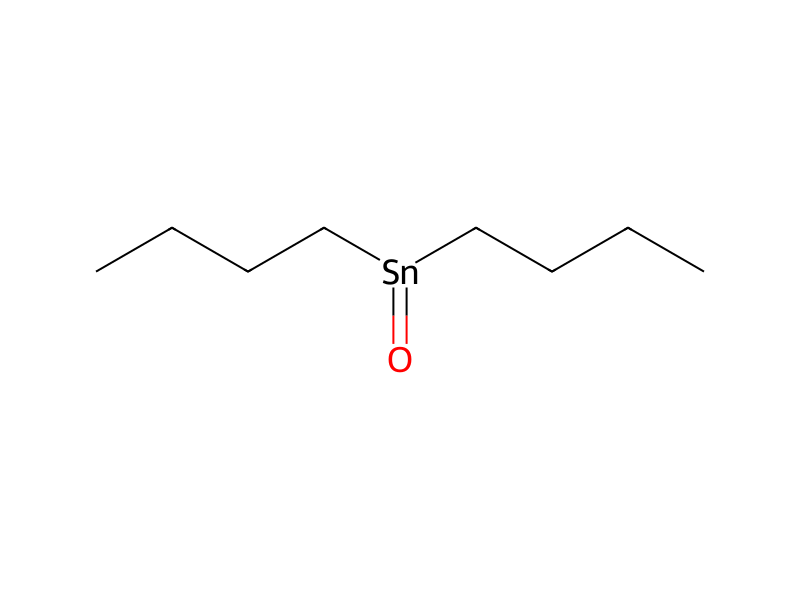
[CH3:1][C:2]([CH3:10])([CH:5]([OH:9])[CH:6]([CH3:8])[CH3:7])[CH2:3][OH:4].[C:11]([OH:19])(=O)[CH2:12][CH2:13][CH2:14][CH2:15][CH2:16][CH3:17]>C(O)(=O)CCCCCC.C([Sn](=O)CCCC)CCC>[C:11]([O:4][CH2:3][C:2]([CH3:10])([CH3:1])[CH:5]([O:9][C:11](=[O:19])[CH2:12][CH2:13][CH2:14][CH2:15][CH2:16][CH3:17])[CH:6]([CH3:8])[CH3:7])(=[O:19])[CH2:12][CH2:13][CH2:14][CH2:15][CH2:16][CH3:17]Participants
5
Reactant 2


Product 1

Reagents, catalysts & solvents 2
Procedure
Into a 3-liter four neck flask equipped with stirrer, thermometer, a nitrogen inlet tube, Dean-Stark trap and condenser was charged 492 grams (3.36 moles) of 2,2,4-trimethyl-1,3-pentanediol; 963 grams n-heptanoic acid (7.40 moles) and 0.1 wt. percent of dibutyl tin oxide as catalyst. The reaction was carried out under reflux conditions at 220° C. to a hydroxyl value <2.0. The excess heptanoic acid was stripped under reduced pressure for a TAN <1.0. The ester was subsequently treated with concentrated caustic, stripped and filtered to yield 1170 grams of 2,2,4-trimethyl-1,3-pentanediol di-n-heptanoate.
Workup
- concentrationwith concentrated caustic
- filtrationfiltered
Sources & evidence
- ORD record
- ord-77dd76de93214a22ba7720cdb2c38a18
- Source dataset
- uspto-grants-1998_01
- Patent number
- US05705086
Reaction notes
Loading…