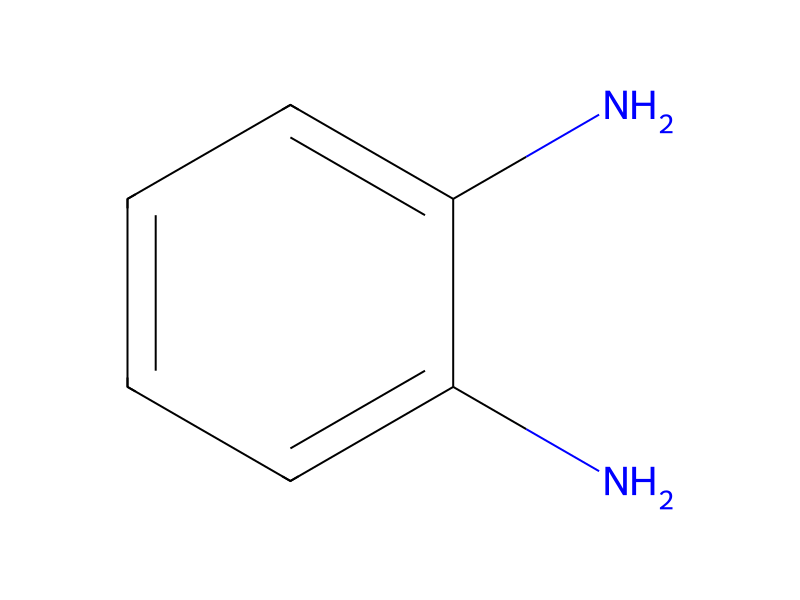
O-Phenylenediamine → 2-(4-Hydroxy-3-methoxy-5-nitrophenyl)quinoxaline
Reaction equation

Br[CH2:2][C:3]([C:5]1[CH:10]=[C:9]([N+:11]([O-:13])=[O:12])[C:8]([OH:14])=[C:7]([O:15][CH3:16])[CH:6]=1)=O.[C:17]1([NH2:24])[CH:22]=[CH:21][CH:20]=[CH:19][C:18]=1[NH2:23].C([O-])(=O)C.[Na+]>CO>[OH:14][C:8]1[C:9]([N+:11]([O-:13])=[O:12])=[CH:10][C:5]([C:3]2[CH:2]=[N:24][C:17]3[C:18](=[CH:19][CH:20]=[CH:21][CH:22]=3)[N:23]=2)=[CH:6][C:7]=1[O:15][CH3:16]Participants
5
Reactant 3


Product 1

Reagents, catalysts & solvents 1

Procedure
ada) A suspension of 14.5 g of 2-bromo-4'-hydroxy-3'-methoxy-5'-nitroacetophenone and 5.41 g of 1,2-phenylenediamine in 350 ml of methanol is treated with 4.92 g of sodium acetate and the mixture is heated to boiling under reflux for 22 hours. The reaction mixture is then evaporated, the residue is dissolved in methylene chloride, this solution is washed four times with water, dried over sodium sulfate, filtered and evaporated. There is obtained 2-(4-hydroxy-3-methoxy-5-nitrophenyl)quinoxaline of m.p. 195°-197° (from methylene chloride/methanol).
Workup
- temperaturethe mixture is heated
- temperatureunder reflux for 22 hours
- customThe reaction mixture is then evaporated
- dissolutionthe residue is dissolved in methylene chloride
- washthis solution is washed four times with water
- dry with materialdried over sodium sulfate
- filtrationfiltered
- customevaporated
Sources & evidence
- ORD record
- ord-4fcd1fe329a1452da72ec9b68e3c6510
- Source dataset
- uspto-grants-1998_01
- Patent number
- US05705703
Reaction notes
Loading…