Tin tetrachloride → 4-Amino-1-(3,4-dibenzoyloxy-5-benzyloxymethyl-3-methyl-tetrahydro-furan-2-yl)-1H-pyrimidine-2-one
Reaction equation

[NH:1]1[CH:8]=[CH:7][C:5]([NH2:6])=[N:4][C:2]1=[O:3].C/C(/O[Si](C)(C)C)=N\[Si](C)(C)C.C(O[C@@H:30]1[O:52][C@H:51]([CH2:53][O:54][C:55](=O)[C:56]2[CH:61]=[CH:60][CH:59]=[CH:58][CH:57]=2)[C@@H:41]([O:42][C:43](=[O:50])[C:44]2[CH:49]=[CH:48][CH:47]=[CH:46][CH:45]=2)[C@@:31]1([CH3:63])[O:32][C:33](=[O:40])[C:34]1[CH:39]=[CH:38][CH:37]=[CH:36][CH:35]=1)(=O)C1C=CC=CC=1.[Sn](Cl)(Cl)(Cl)Cl>C(#N)C>[NH2:6][C:5]1[CH:7]=[CH:8][N:1]([CH:30]2[C:31]([O:32][C:33](=[O:40])[C:34]3[CH:35]=[CH:36][CH:37]=[CH:38][CH:39]=3)([CH3:63])[CH:41]([O:42][C:43](=[O:50])[C:44]3[CH:45]=[CH:46][CH:47]=[CH:48][CH:49]=3)[CH:51]([CH2:53][O:54][CH2:55][C:56]3[CH:57]=[CH:58][CH:59]=[CH:60][CH:61]=3)[O:52]2)[C:2](=[O:3])[N:4]=1Participants
Reactant 4


Product 1

Reagents, catalysts & solvents 1
Conditions
- Temperature
- 20 °C
Procedure
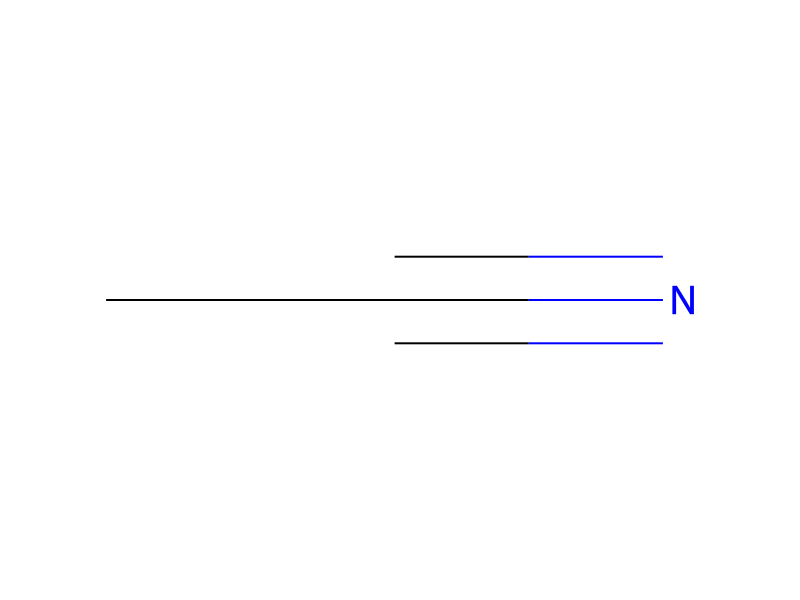
Cytosine (89 g, 0.80 mol) was suspended in acetonitrile (900 ml) in a 12 L round bottomed flask equipped with a reflux condenser, overhead stirrer and an argon inlet adapter. The suspension was stirred at 20° C. under argon atmosphere and N,O-bis(trimethylsilyl)acetamide (537 ml, 2.2 mol) was added in one portion. The resulting solution was heated to 80° C. and stirred for an additional hour at the same temperature. 1,2,3,5-tetra-O-benzoyl-2-C-methyl-β-D-ribofuranose (425.0 g, 0.73 mol) was suspended in acetonitrile (4000 ml) and added to the reaction mixture. The reaction mixture became clear after a few minutes and the temperature dropped to ca. 50° C. Tin(IV) chloride (154 ml, 1.31 mol) was added over a period of 15 minutes and stirring was continued at 80°. After one hour, an aliquot of reaction mixture was quenched by adding aqueous sodium bicarbonate solution and extracting the aqueous layer with ethyl acetate. The ethyl acetate layer was examined by TLC (silica gel, 20% ethyl acetate in heptane, Rf for sugar derivative: 0.40). TLC analysis indicated the complete consumption of the sugar derivative. Desired product was detected by TLC using 10% methanol in dichloromethane (Rf: 0.37). The reaction was also monitored by HPLC (Method # 2). Reaction mixture was cooled to 20° C. and quenched by adding saturated aqueous sodium bicarbonate solution (3000 ml) over a period of 30 minutes (observed an exotherm when added the first few drops of the sodium bicarbonate solution). Solid sodium bicarbonate (1350 g) was added in portions to avoid foaming. The mixture was checked to make sure that its pH is ≧7. Agitation was stopped and layers were allowed to separate for 20 minutes. The aqueous layer was drained and stirred with ethyl acetate (1500 ml) and the mixture was allowed to separate (30 minutes). The organic layer was isolated and combined with the acetonitrile solution. The organic solution was washed with brine (500 ml) and then solvent stripped to a volume of ca. 750 ml. Product can be used as is in the subsequent reaction. It may also be further stripped to white foamy solid, in quantitative yield. Structure of compound 10 was confirmed by 1H NMR analysis.
Workup
- customequipped with a reflux condenser, overhead stirrer and an argon inlet adapter
- temperatureThe resulting solution was heated to 80° C.
- stirringstirred for an additional hour at the same temperature
- additionadded to the reaction mixture
- waitThe reaction mixture became clear after a few minutes
- additionthe temperature dropped to ca. 50° C
- stirringstirring
- customwas continued at 80°
- customan aliquot of reaction mixture
- customwas quenched
- additionby adding aqueous sodium bicarbonate solution
- extractionextracting the aqueous layer with ethyl acetate
- customthe complete consumption of the sugar derivative
- customReaction mixture
- temperaturewas cooled to 20° C.
- customquenched
- additionby adding saturated aqueous sodium bicarbonate solution (3000 ml) over a period of 30 minutes (
- additionadded the first few drops of the sodium bicarbonate solution)
- additionSolid sodium bicarbonate (1350 g) was added in portions
- customto separate for 20 minutes
- stirringstirred with ethyl acetate (1500 ml)
- customto separate (30 minutes)
- customThe organic layer was isolated
- washThe organic solution was washed with brine (500 ml)
- customas is in the subsequent reaction
Sources & evidence
- ORD record
- ord-0514a5060d244e079b28320b1a49cc69
- Source dataset
- uspto-grants-2009_09
- Patent number
- US07582618B2
Reaction notes
Loading…