Hydrazine → 2-Amino-5-nitrobenzenethiol
Reaction equation

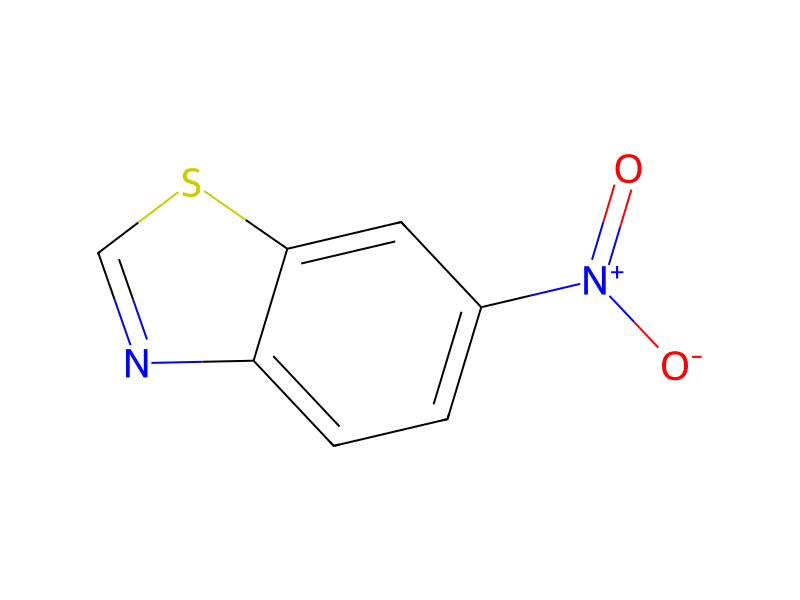
[N+:1]([C:4]1[CH:12]=[CH:11][C:7]2[N:8]=C[S:10][C:6]=2[CH:5]=1)([O-:3])=[O:2].NN>>[NH2:8][C:7]1[CH:11]=[CH:12][C:4]([N+:1]([O-:3])=[O:2])=[CH:5][C:6]=1[SH:10]Participants


Procedure
Commercially available 6-nitrobenzothiazole can be treated with hydrazine to obtain the 2-amino-5-nitro-benzenethiol, which can subsequently be reacted with chloroacetoacetate to give the (7-nitro-4H-benzo[1,4]thiazin-3-yl)-acetic acid ethyl ester. Reduction of the nitro group to the amino group can be accomplished by reaction with tin(II) chloride. Subsequent reaction with methansulfonyl chloride can be used to obtain the corresponding sulfonamide. Protection of both nitrogens with a suitable protecting group such as a Boc group can be achieved by using standard methods for protecting amino groups. The sulfide can be oxidized using a suitable oxidizing reagent (e.g., MCPBA) to give the sulfone. Finally, deprotection of the amino groups using trifluoroacetic acid can be used to afford the desired (7-methanesulfonylamino-1,1-dioxo-1,4-dihydro-1λ6-benzo[1,4]thiazin-3-yl)-acetic acid ethyl ester intermediate.
Sources & evidence
- ORD record
- ord-9fafaaada9f0446eb500b8709efb8d4a
- Source dataset
- uspto-grants-2009_09
- Patent number
- US07582754B2
Reaction notes
Loading…