Water → Carbazole
Reaction equation

F[C:2]1[CH:3]=[C:4]2[C:8](=[CH:9][CH:10]=1)[NH:7][CH:6]=[CH:5]2.O>CC(C)=O>[CH:9]1[C:8]2[NH:7][C:6]3[C:5](=[CH:3][CH:2]=[CH:10][CH:9]=3)[C:4]=2[CH:3]=[CH:2][CH:10]=1Participants
Reactant 2

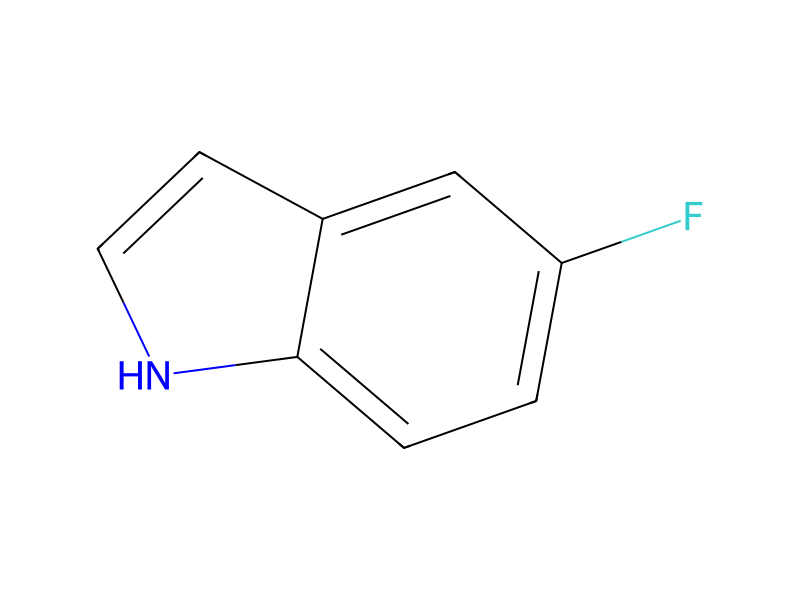
Product 1

Reagents, catalysts & solvents 1

Procedure
15 ml of acetone was poured into a 200 ml three-neck flask, and 1.62 g of 5-fluoroindole was dissolved therein. On the other hand, preparation of an oxidant solution was performed by dissolving 32.2 g of cupric chloride anhydrate and 12.9 g of water in 55 ml of acetone and agitating the mixture for 5 minutes. Then the prepared oxidant solution was dripped into the 5-fluoroindole solution for two hours and the resultant mixture solution was agitated for 5 hours at the temperature of 30° C. Color of the reaction solution changed from white to dark blue with slight heat generation. pH of the reaction solution was less than 1. After the end of the reaction, the reaction liquid was suction-filtered with a perforated funnel, and the filtrate was washed with acetone and then methanol and dried to obtain 1.04 g of 2,9,14-trifluoro-6,11-dihidro-5H-diindolo [2,3,-a:2′,3′-c] carbazole (5-fluoroindole trimer) (yield: 64%). The resultant trimer was pressure-molded with a tablet molding machine and the mold was cut into a piece with the diameter of 10 mm and thickness of 1 mm. A conductivity thereof was measured by the four terminal method and found to be 0.88 S/cm. The result of elemental analysis was: <C8.00H3.95N1.10F0.96Cl0.10>3.
Workup
- customOn the other hand, preparation of an oxidant solution
- customAfter the end of the reaction
- customthe reaction liquid
- filtrationwas suction-filtered with a perforated funnel
- washthe filtrate was washed with acetone
- dry with materialmethanol and dried
Sources & evidence
- ORD record
- ord-7580f0bb08a9435d842f589140e352de
- Source dataset
- uspto-grants-2009_09
- Patent number
- US07585981B2
Reaction notes
Loading…