2-(4-Bromophenyl)ethanol → 4-Bromophenethyl 3-cyanophenylcarbamate
Reaction equation

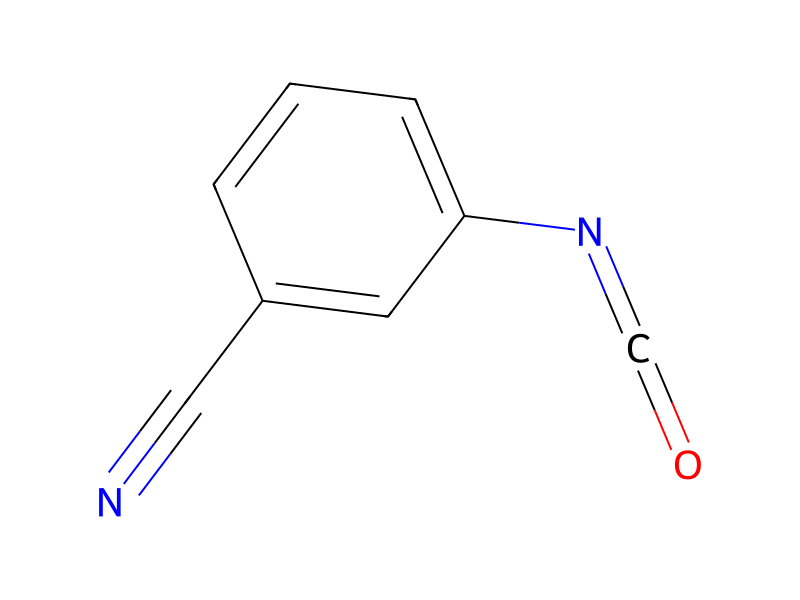
[C:1]([C:3]1[CH:4]=[C:5]([N:9]=[C:10]=[O:11])[CH:6]=[CH:7][CH:8]=1)#[N:2].[Br:12][C:13]1[CH:18]=[CH:17][C:16]([CH2:19][CH2:20][OH:21])=[CH:15][CH:14]=1>C1(C)C=CC=CC=1.CC(C)([O-])C.CC(C)([O-])C.CC(C)([O-])C.CC(C)([O-])C.[Ti+4]>[Br:12][C:13]1[CH:18]=[CH:17][C:16]([CH2:19][CH2:20][O:21][C:10](=[O:11])[NH:9][C:5]2[CH:6]=[CH:7][CH:8]=[C:3]([C:1]#[N:2])[CH:4]=2)=[CH:15][CH:14]=1Participants
Reactant 2

Product 1

Reagents, catalysts & solvents 2


Procedure
Titanium tetra-tert-butoxide (0.080 mL, 0.21 mmol) was added dropwise to a solution of 3-cyanophenylisocyanate (228 mg, 1.58 mmol) and 2-(4-bromophenyl)ethanol (606 mg, 3.01 mmol) in toluene (10 mL). A precipitate formed immediately and the reaction was stirred for 2 h at rt. The reaction was quenched with saturated ammonium chloride solution and extracted with DCM (3×). The combined organic layers were washed with brine, dried (MgSO4), and concentrated in vacuo. The residual solid was triturated with DCM hexane to give 11A (543 mg, 100%) as a white solid. 1H NMR (400 MHz, CDCl3) δ 2.95 (t, J=6.81 Hz, 2 H), 4.38 (t, J=6.81 Hz, 2 H), 6.68 (s, 1 H), 7.11 (d, J=8.35 Hz, 2 H), 7.31-7.35 (m, 1 H), 7.38 (t, J=7.91 Hz, 1 H), 7.44 (d, J=8.35 Hz, 2 H), 7.52 (d, J=7.03 Hz, 1 H), 7.76 (s, 1 H).
Workup
- customA precipitate formed immediately
- customThe reaction was quenched with saturated ammonium chloride solution
- extractionextracted with DCM (3×)
- washThe combined organic layers were washed with brine
- dry with materialdried (MgSO4)
- concentrationconcentrated in vacuo
- customThe residual solid was triturated with DCM hexane
Sources & evidence
- ORD record
- ord-ce29737be8674d5798bc2277a3ec33fa
- Source dataset
- uspto-grants-2009_09
- Patent number
- US07592331B2
Reaction notes
Loading…