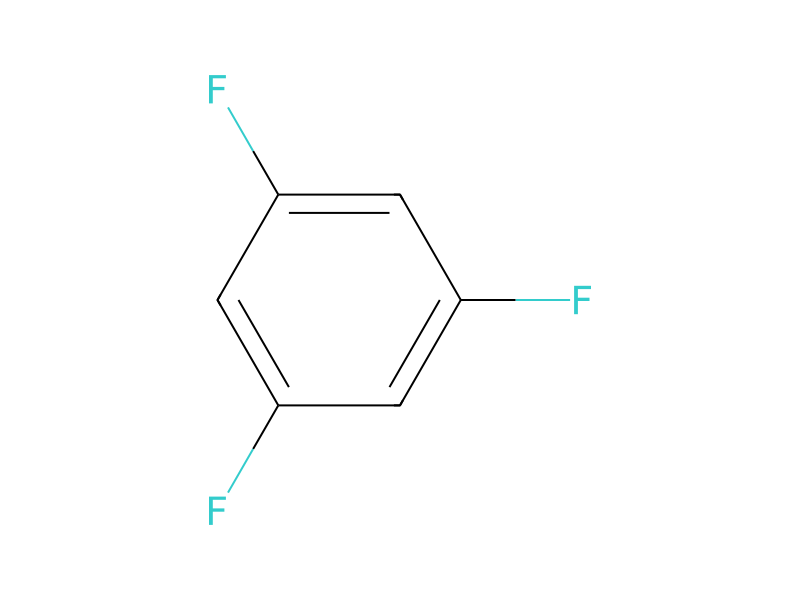
1,3,5-Trichloro-2,4,6-trifluorobenzene → 1,3,5-Trifluorobenzene
Reaction equation

Cl[C:2]1[C:7]([F:8])=[C:6](Cl)[C:5]([F:10])=[C:4](Cl)[C:3]=1[F:12].C([O-])(=O)C.[Na+]>[Pd].O>[F:8][C:7]1[CH:2]=[C:3]([F:12])[CH:4]=[C:5]([F:10])[CH:6]=1Participants
5
Reactant 2


Product 1
Reagents, catalysts & solvents 2


Conditions
- Temperature
- 140 °C
Procedure
Palladium on carbon (10%, 410 mg), 100 g of water, 21.8 g of 1,3,5-trichloro-2,4,6-trifluorobenzene and 32.9 g of sodium acetate (4.5 equivalents) were placed in a pressure vessel. After flushing with nitrogen, the pressure vessel was heated to 140° C. and pressurized with 12 bar of hydrogen. A hydrogen pressure of 12 bar was maintained at 140° C. for about 12 hours while stirring vigorously. After cooling to 20-25° C., the pressure vessel was depressurized. The two-phase reaction solution was filtered and the phases were then separated. This gave a yield of 88.2% of 1,3,5-trifluorobenzene.
Workup
- customAfter flushing with nitrogen
- temperatureA hydrogen pressure of 12 bar was maintained at 140° C. for about 12 hours
- temperatureAfter cooling to 20-25° C.
- customThe two-phase reaction solution
- filtrationwas filtered
- customthe phases were then separated
Sources & evidence
- ORD record
- ord-c4bdb7eec03f462c993e6fd1a1db2208
- Source dataset
- uspto-grants-2009_09
- Patent number
- US07595426B2
Reaction notes
Loading…