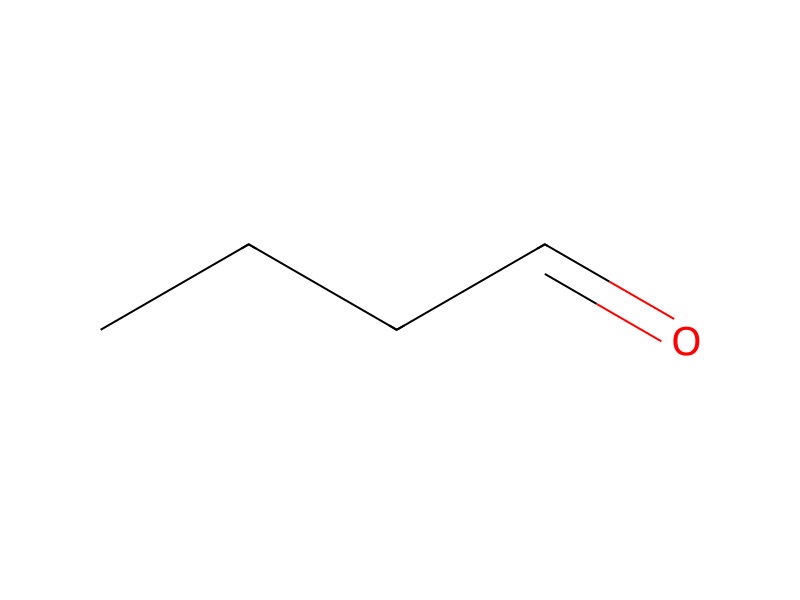
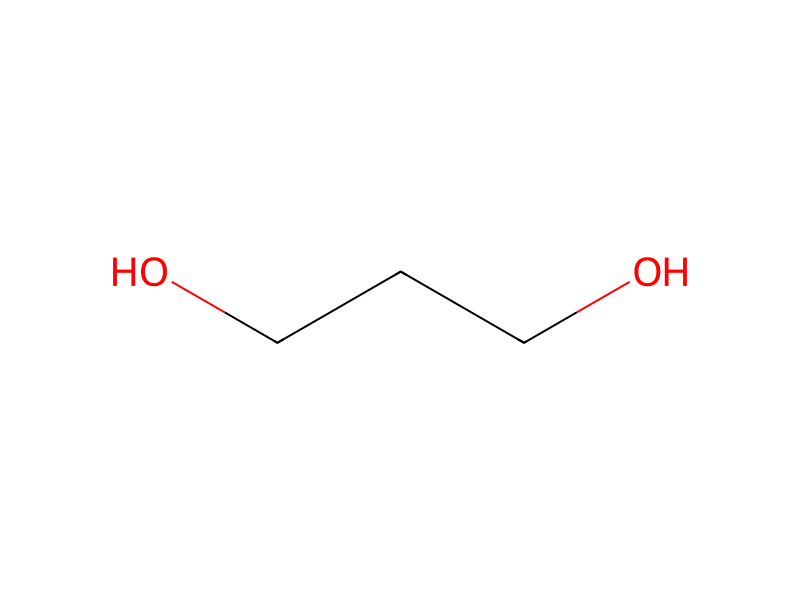
Butanal → 2-Propyl-1,3-dioxane
Reaction equation

[CH:1](=[O:5])[CH2:2][CH2:3][CH3:4].[CH2:6](O)[CH2:7][CH2:8][OH:9].P(=O)(O)(O)O.C(=O)CCC.O>O>[CH2:2]([CH:1]1[O:9][CH2:8][CH2:7][CH2:6][O:5]1)[CH2:3][CH3:4]Participants
6
Reactant 4


Product 1

Reagents, catalysts & solvents 1

Procedure
Examples 5-7 are carried out using the apparatus described above. Prior to each example, the column is heated to 100° C. with boiling water as described above. Butyraldehyde is fed through the bottom feed plate and a mixture of 1,3-propanediol and 500 ppmw phosphoric acid is fed through the upper feed plate at rates described in Table I. A butyraldehyde/water azeotrope is condensed overhead at 73° C. The basepot reaches a maximum temperature of 165° C. Material is removed from the basepot throughout the run. The material separates into two phases, each of which is analyzed by gas chromatography. The results are listed in Table II.
Workup
- customcondensed overhead at 73° C
- customa maximum temperature of 165° C
- customMaterial is removed from the basepot throughout the run
Sources & evidence
- ORD record
- ord-f8a3daac2477484bad7123e64e1056c4
- Source dataset
- uspto-grants-2014_09
- Patent number
- US08829207B2
Reaction notes
Loading…