NT2 purpurin → 21H,22H-Porphine
Reaction equation

CC[CH:3]1[C:23]2(CC)[C:24]3=[N:25][C:4]1=[CH:5][C:6]1[NH:10][C:9]([CH:11]=[C:12]4[NH:39][C:15](=[CH:16][C:17]5[C:34](CC)=[C:33](CC)[C:19](=[C:20]3C=C2C(OCC)=O)[N:18]=5)[C:14](CC)=[C:13]4CC)=[C:8](CC)[C:7]=1CC>ClCCl>[C:6]12[CH:5]=[C:4]3[N:25]=[C:24]([CH:23]=[CH:3]3)[CH:20]=[C:19]3[NH:18][C:17]([CH:34]=[CH:33]3)=[CH:16][C:15]3=[N:39][C:12]([CH:13]=[CH:14]3)=[CH:11][C:9]([NH:10]1)=[CH:8][CH:7]=2Participants
Reactant 1

Product 1
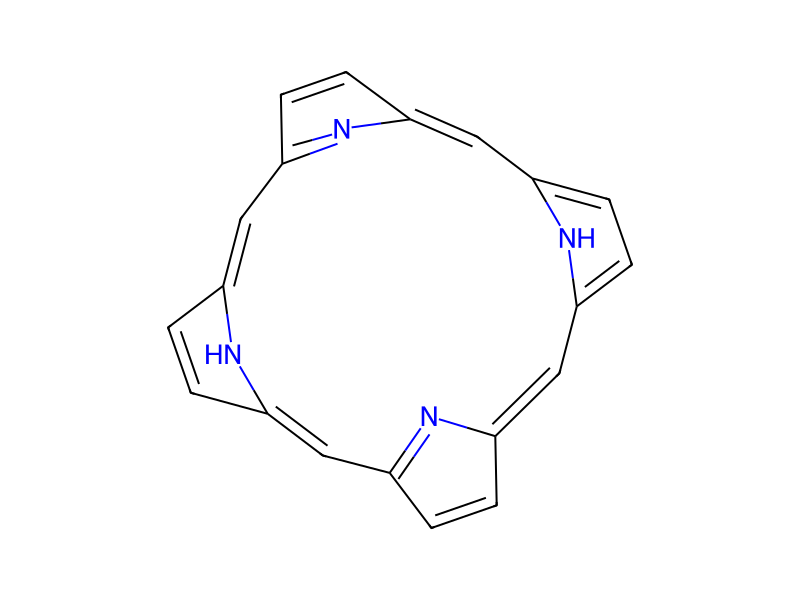
Reagents, catalysts & solvents 1

Procedure
A 50 mg portion of Purpurin NT2 was dissolved in 20 ml dichloromethane, and the resulting solution was allowed to stand for a total of 16 hours in sunlight, in contact with air, and under ambient conditions (temperature about 22°). The dichloromethane was then removed by evaporation, leaving 50 mg porphyrin derivative (hereafter "Porphyrin NT2") which was found by nuclear magnetic resonance to have the formula of FIG. 7 of the attached drawings where R1 through R8 are ethyl, R10 through R12 are hydrogen, and R13 is CH2CH3. The production of Purpurin NT2 is described in Example 1 of PCT/US86/02824; it has the formula of FIG. 5 of the drawings of that application where R1 through R8 are ethyl, R9 is CO2CH2CH3, and R10 through R13 are hydrogen.
Workup
- customto stand for a total of 16 hours in sunlight, in contact with air
- customunder ambient conditions (temperature about 22°)
- customThe dichloromethane was then removed by evaporation
Sources & evidence
- ORD record
- ord-03132c9ab6a2405cb9ba4e9ebe56e992
- Source dataset
- uspto-grants-1996_09
- Patent number
- US05552134
Reaction notes
Loading…