Water → 4-(Furan-3-yl)-7-methylquinoline
Reaction equation

Cl[C:2]1[CH:11]=[C:10]2[C:5]([C:6]([C:12]3[CH:16]=[CH:15][O:14][CH:13]=3)=[CH:7][CH:8]=[N:9]2)=[CH:4][CH:3]=1.[CH3:17][Mg+].[Br-].[NH4+].[Cl-].O>CCOCC.Cl[Ni]1(Cl)[P](C2C=CC=CC=2)(C2C=CC=CC=2)CCC[P]1(C1C=CC=CC=1)C1C=CC=CC=1>[O:14]1[CH:15]=[CH:16][C:12]([C:6]2[C:5]3[C:10](=[CH:11][C:2]([CH3:17])=[CH:3][CH:4]=3)[N:9]=[CH:8][CH:7]=2)=[CH:13]1Participants
7



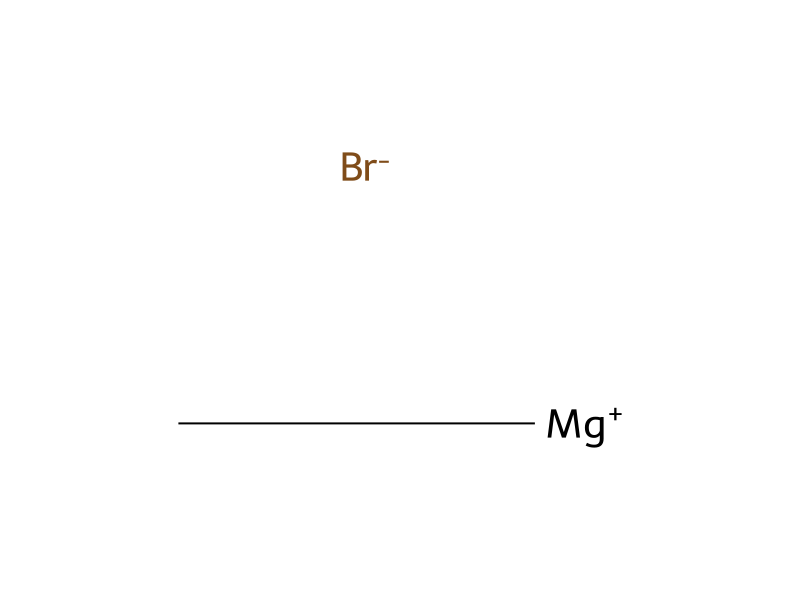



Conditions
- Temperature
- 30 °C
Procedure
To a mixture of 7-chloro-4-(furan-3-yl)quinoline (30.2 g) and [1,3-bis(diphenylphosphino)propane]nickel (II) chloride (7.1 g) in Et2O (950 mL) was added MeMgBr (141 mL, 1.4M in 3:1 THF:toluene) at such a rate to maintain a temperature of 30° C. The mixture was refluxed for 30 min., cooled to 0° C. and saturated NH4Cl (200 mL) was added followed by H2O (100 mL). The layers were separated and the aqueous phase was extracted with EtOAc. The combined organics were washed with NH4OAc buffer, brine, dried (MgSO4) and concentrated. Chromatography (silica gel;EtOAc/hexane (3:7)) provided the title compound as a beige oil.
Workup
- temperatureThe mixture was refluxed for 30 min.
- temperaturecooled to 0° C.
- customThe layers were separated
- extractionthe aqueous phase was extracted with EtOAc
- washThe combined organics were washed with NH4OAc buffer, brine
- dry with materialdried (MgSO4)
- concentrationconcentrated
Sources & evidence
- ORD record
- ord-07cefc43d8834002ad853d126d18dce2
- Source dataset
- uspto-grants-1996_09
- Patent number
- US05552437
Reaction notes
Loading…