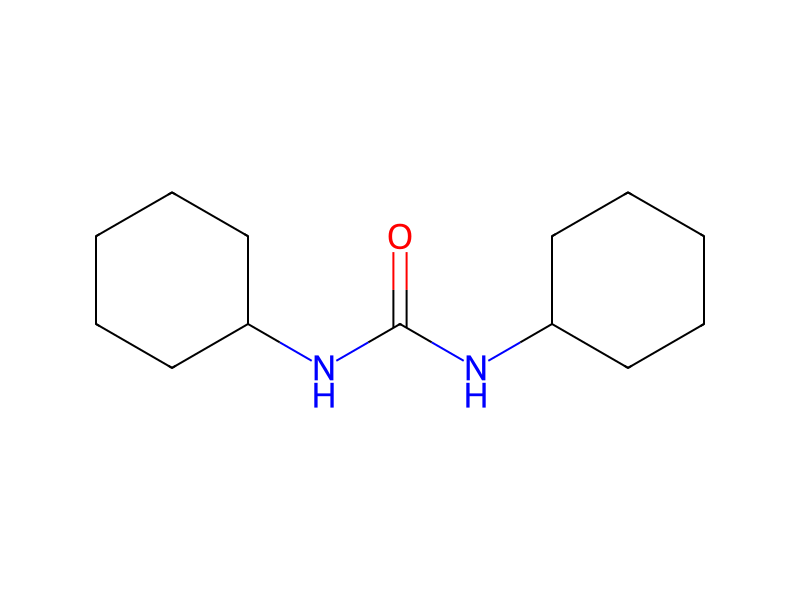
4-Nitrophenol → N,N'-Dicyclohexylurea
Reaction equation

N1C=CC=CC=1.C1C([N+]([O-])=[O:14])=CC=C(O)C=1.[CH:17]1([N:23]=[C:24]=[N:25][CH:26]2[CH2:31][CH2:30][CH2:29][CH2:28][CH2:27]2)[CH2:22][CH2:21][CH2:20][CH2:19][CH2:18]1>O1CCOCC1>[CH:26]1([NH:25][C:24]([NH:23][CH:17]2[CH2:18][CH2:19][CH2:20][CH2:21][CH2:22]2)=[O:14])[CH2:31][CH2:30][CH2:29][CH2:28][CH2:27]1Participants
5
Reactant 3



Product 1
Reagents, catalysts & solvents 1

Procedure
The succinylated 2-azetidinone is dissolved in dioxane (10 ml). Anhydrous pyridine (1 ml) and p-nitrophenol (0.2 g) are added followed by dicyclohexylcarbodiimide (0.6 g, 2.5 mmole). Stirring is continued for 3 hours. The dicyclohexyl-urea formed is filtered and the filtrate is added to controlled pore glass (5 g) suspended in dimethylformamide (5 ml). Triethylamine (2 ml) is added and briefly shaken. After leaving it overnight, the CPG is filtered, washed with methanol, ether and air dried.
Sources & evidence
- ORD record
- ord-b862b009dea744fda672e8dd5b5650a8
- Source dataset
- uspto-grants-1996_09
- Patent number
- US05554746
Reaction notes
Loading…