Ammonia → Benzoic acid, 2-amino-3-chloro-, methyl ester
Reaction equation

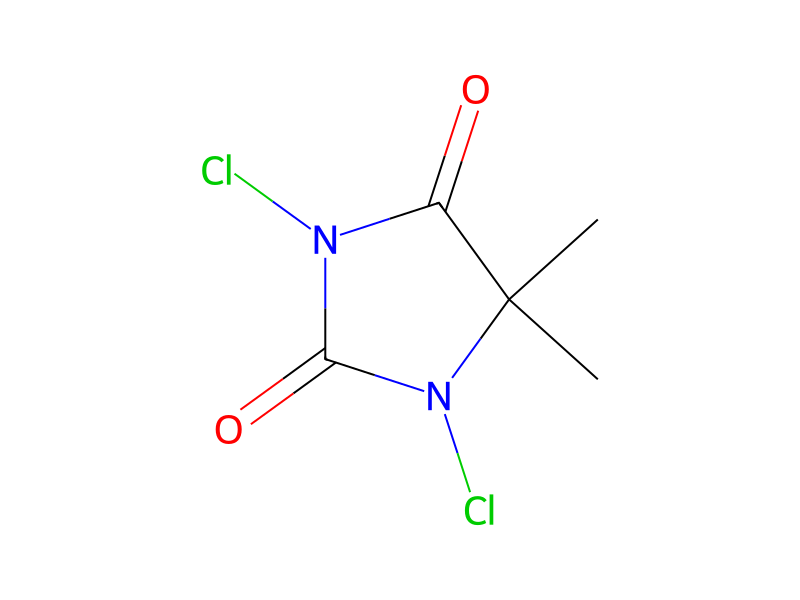
[Cl:1][C:2]1[CH:12]=[CH:11][CH:10]=[C:4]2[C:5]([O:7][C:8](=O)[C:3]=12)=[O:6].N.Cl[N:15]1C(C)(C)C(=O)N(Cl)C1=O>>[Cl:1][C:2]1[CH:12]=[CH:11][CH:10]=[C:4]([C:5]([O:7][CH3:8])=[O:6])[C:3]=1[NH2:15]Participants



Procedure
Pure 3-chloroanthranilic alkyl esters have previously been prepared only in a 5-step synthesis starting from anthranilic esters (U.S. Pat. No. 5,068,392). According to U.S. Pat. No. 5,068,392, (pure) 3-chloroanthranilic alkyl esters can be prepared starting from anthranilic esters by means of a 5-step synthesis. The amino group of the anthranilic alkyl ester is first acetylated, bromination then takes place in the para position to the acetylated amino group, and this is then followed by chlorination in the ortho position to the acetylated amino group. Subsequently, the bromine is removed by reduction and the acetamino group is de-acetylated. The process is fairly elaborate and is found to be problematical owing to the use of bromine chloride or elemental bromine and chlorine. In addition to this, a series of unwanted waste products is inevitably formed. Apart from this, the preparation of 3-chloroanthranilic alkyl esters has only been described in the form of a mixture together with chloroanthranilic alkyl esters substituted in the 5 or 6 positions. Thus, according to EP 20 969, 3-chlorophthalic anhydride is reacted with ammonia, alkali metal hydroxide and alkali metal hypochlorite, and the resulting mixture of 5-chloroisatoic and 8-chloroisatoic anhydrides is esterified with alkanols to give a mixture of 3-chloroanthranilic and 6-chloroanthranilic alkyl esters. 5-Chloroanthranilic and 3,5-dichloroanthranilic alkyl esters arise as by-products in the amounts of from 23 to 48% and from 2 to 6%, respectively, when 3-chloroanthranilic alkyl esters are prepared in accordance with U.S. Pat. No. 5,118,832 by the reaction of anthranilic esters with 1,3-dichloro-5,5-dimethylhydantoin. After complicated removal of the by-products, methyl 3-chloroanthranilate is obtained in 49.6% yield.
Workup
- customSubsequently, the bromine is removed by reduction
- additionIn addition to this, a series of unwanted waste products
- customis inevitably formed
- customto give
- customremoval of the by-products
Sources & evidence
- ORD record
- ord-8fec6120115f4b23af705f9fdbe77d8b
- Source dataset
- uspto-grants-1996_09
- Patent number
- US05557005
Reaction notes
Loading…