Ampicillin → Punicic Acid
Reaction equation

CC[N+]1[C:16]([C:17]2C=CC=[CH:21][CH:22]=2)=[C:15]2[C:10]([CH:11]=[CH:12][C:13](N)=[CH:14]2)=[C:9]2[C:4]=1[CH:5]=[C:6](N)[CH:7]=[CH:8]2.[Br-].C1(O)C=CC=CC=1.C(Cl)(Cl)Cl.C(O)CC(C)C.[C:43]([O-:46])(=[O:45])[CH3:44].[Na+].CC1(C)S[C@@H]2[C@H](NC([C@H](N)C3C=CC=CC=3)=O)C(=O)N2[C@H]1C(O)=O.C1C2NC=C(O[C@@H]3O[C@H](CO)[C@H](O)[C@H](O)[C@H]3O)C=2C(Cl)=C(Br)C=1>O.C(O)C>[C:43]([OH:46])(=[O:45])[CH2:44][CH2:4][CH2:5][CH2:6][CH2:7][CH2:8][CH2:9]/[CH:10]=[CH:11]\[CH:12]=[CH:13]\[CH:14]=[CH:15]/[CH2:16][CH2:17][CH2:22][CH3:21]Participants
Reactant 5


Product 1

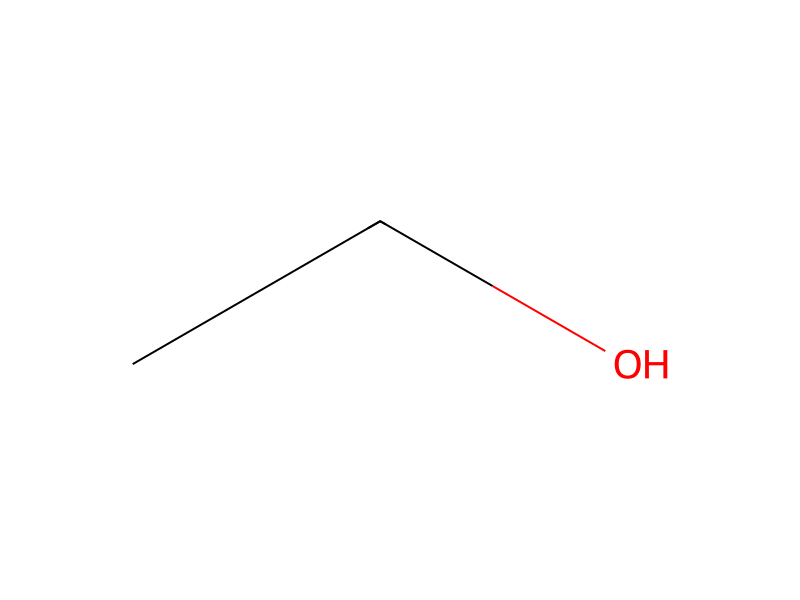
Reagents, catalysts & solvents 2
Conditions
- Temperature
- 94 °C
Procedure
1 μl of a solution obtained by diluting the first strand cDNA solution synthesized in (2) above with a TE buffer to 1/20, 1 μM each of primers shown in SEQ ID NOS: 14 and 16, and 2.5 units of Takara Ex Taq DNA polymerase (Takara Bio Inc.) were added to a PCR reaction solution so as to prepare the total 50 μl of a solution, which was then subjected to a PCR reaction under the following conditions. This is to say, after heating at 94° C. for 1 minute, a cycle consisting of denaturation at 94° C. for 30 seconds, annealing at 52° C. for 1 minute, and elongation at 72° C. for 40 seconds was repeated 30 times, and finally the reaction product was heated at 72° C. for 10 minutes. After completion of the reaction, an aliquot of the reaction solution was subjected to 1% agarose gel electrophoresis, and then stained with ethidium bromide. As a result, a band of the expected size was confirmed. Thus, the reaction solution was deproteinized with 50 μl of phenol/chloroform/isoamyl alcohol (25:24:1), and the upper layer was transferred into a new tube. 5 μl of a 3 M-sodium acetate solution (pH 5.2) and 125 μl of ethanol were added thereto, and the mixture was left at rest at −80° C. for 15 minutes, and then subjected to centrifugal separation at 14,000 g for 10 minutes, so as to obtain a precipitate containing DNA fragments. This precipitate was dissolved in 10 μl of sterilized water, and the product was subjected to 0.8% agarose gel electrophoresis and then stained with ethidium bromide. Thereafter, a band of a size of interest was cut out of the gel, and a solution containing amplified fragments was recovered using SUPREC-01 (manufactured by Takara Bio Inc.), followed by ethanol precipitation. Thereafter, the purified DNA fragment was dissolved in 10 μl of sterilized water. 4.5 μl from the obtained solution was mixed with 0.5 μl (25 ng) of a plasmid vector pGEM-T Easy (manufactured by Promega), and the obtained mixture was then subjected to a ligation reaction at 16° C. overnight, using a DNA ligation kit (manufactured by Takara Bio Inc.) Using 2 μl from the reaction solution, Escherichia coli (DH5α) was transformed by Hanahan's method (DNA cloning, vol. 1, pp. 109-136 (1985)), so as to obtain white colonies that were formed on an LB medium containing ampicillin (50 μg/ml) and X-gal.
Workup
- additionby diluting the first strand cDNA solution
- customwas then subjected to a PCR reaction under the following conditions
- waitannealing at 52° C. for 1 minute
- waitelongation at 72° C. for 40 seconds was repeated
- temperature30 times, and finally the reaction product was heated at 72° C. for 10 minutes
- customAfter completion of the reaction
- customthe upper layer was transferred into a new tube
- waitthe mixture was left at rest at −80° C. for 15 minutes
- customsubjected to centrifugal separation at 14,000 g for 10 minutes
- customso as to obtain a precipitate
- additiona solution containing
- customwas recovered
- customfollowed by ethanol precipitation
- dissolutionThereafter, the purified DNA fragment was dissolved in 10 μl of sterilized water
- addition4.5 μl from the obtained solution was mixed with 0.5 μl (25 ng) of a plasmid
- customthe obtained mixture was then subjected to a ligation reaction at 16° C. overnight
- custom109-136 (1985)), so as to obtain white colonies that
- customwere formed on an LB medium
Sources & evidence
- ORD record
- ord-53dcafcd37a6485faebe21709a9f4aee
- Source dataset
- uspto-grants-2008_07
- Patent number
- US07402418B2
Reaction notes
Loading…