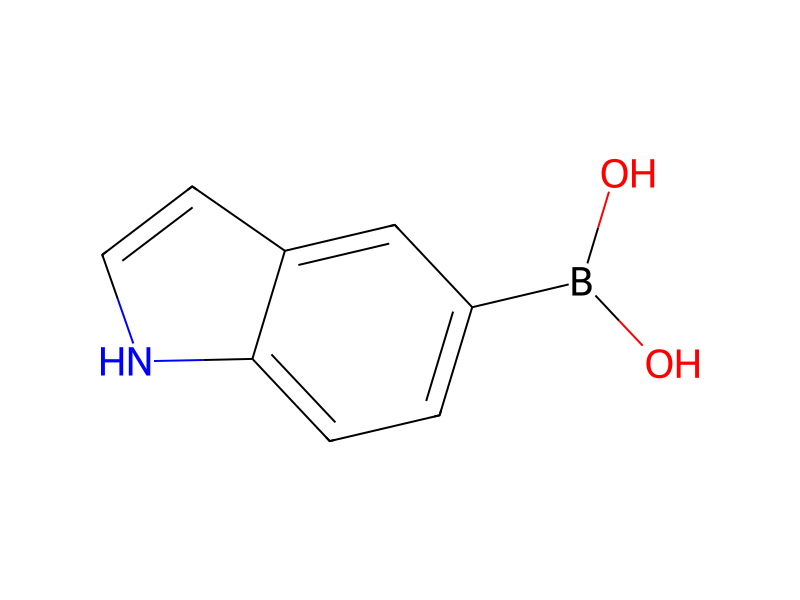
5-Indolylboronic acid → 5-(2-pyridin-2-yl-5,6-dihydro-4H-pyrrolo[1,2-b]pyrazol-3-yl)-1H-indole
Reaction equation

[NH:1]1[C:9]2[C:4](=[CH:5][C:6](B(O)O)=[CH:7][CH:8]=2)[CH:3]=[CH:2]1.Br[C:14]1[C:18]([C:19]2[CH:24]=[CH:23][CH:22]=[CH:21][N:20]=2)=[N:17][N:16]2[CH2:25][CH2:26][CH2:27][C:15]=12>>[N:20]1[CH:21]=[CH:22][CH:23]=[CH:24][C:19]=1[C:18]1[C:14]([C:6]2[CH:5]=[C:4]3[C:9](=[CH:8][CH:7]=2)[NH:1][CH:2]=[CH:3]3)=[C:15]2[CH2:27][CH2:26][CH2:25][N:16]2[N:17]=1Participants
3


Procedure
In a similar fashion to Example 1, react 1H-indole-5-boronic acid (Fluka; 150 mg, 0.95 mmol) with 3-bromo-2-(pyridin-2-yl)-5,6-dihydro-4H-pyrrolo[1,2-b]pyrazole (Preparation 4; 250 mg, 0.95 mmol) to provide the title compound (10 mg, 4%) as an off-white solid. MS ESI+ m/e 301 (M+1). 1H NMR (CDCl3) δ 8.67-8.58 (m, 1H), 7.61 (s, 1H), 7.52-7.45 (m, 1H), 7.39-7.29 (m, 2H), 7.21-7.16 (m, 1H), 7.14-7.04 (m, 2H), 6.52-6.48 (m, 1H), 4.31-4.21 (m, 2H), 3.06-2.98 (m, 2H), 2.73-2.60 (m, 2H). TLC (SiO2): Rf 0.4 (1:3 [80:18:2 chloroform/methanol/concentrated aqueous ammonium hydroxide]/dichloromethane).
Sources & evidence
- ORD record
- ord-a2bab78686204b9b8a0a4d00ba53f289
- Source dataset
- uspto-grants-2008_07
- Patent number
- US07405299B2
Reaction notes
Loading…