Barium Sulfate → L-tert-Leucine
Reaction equation

S([O-])([O-])(=O)=O.[Na+].[Na+].S(O)(O)(=O)=O.[NH2:13][C@H:14]([C:19]([OH:21])=[O:20])[C:15]([CH3:18])([CH3:17])[CH3:16].[OH-].[Ba+2].[OH-].S([O-])([O-])(=O)=O.[Ba+2]>>[NH2:13][C@H:14]([C:19]([OH:21])=[O:20])[C:15]([CH3:18])([CH3:17])[CH3:16]Participants

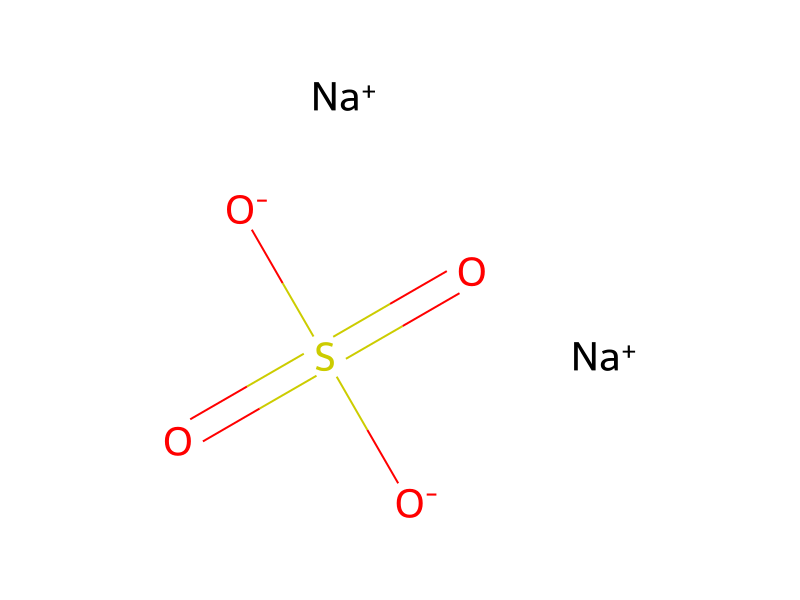


Procedure
The diastereomeric L-tert-leucine dibenzoyl-d-tartrate salt can be hydrolyzed by treating with either acid or a base. When base was used, isolation of both L-tert-leucine and dibenzoyl-d-tartaric acid was difficult as they formed soluble salts. Hence, acid hydrolysis was attempted. When sulphuric acid was used for the hydrolysis of the salt, dibenzoyl-d-tartaric acid precipitated out quantitively. The L-tert-leucine sulphate remained in solution. Recovering L-tert-leucine from its sulphate salt was found to be very problematic. When a common base such as sodium hydroxide or sodium carbonate was used to hydrolyze the sulphate salt, the L-tert-leucine obtained was always found to be contaminated with significant amount of sodium sulphate. Ion exchange resin was not preferred to remove the salts because it adds to the operations and cost and may not be viable on an industrial scale. Hence we selected barium hydroxide as a base for hydrolysis because of the poor solubility of barium sulphate in water. When the aqueous solution of L-tert-leucine sulphate was carefully treated with barium hydroxide, barium sulphate precipitated out leaving pure L-tert-leucine in the solution. The solvent was removed under reduced pressure, the residue obtained was stirred with small amount of acetone to obtain colorless shining solid completely free from any sulphate. The isolated L-tert-leucine showed 99.9% chiral purity and 99.9% chemical purity with 85% yield.
Workup
- customto remove the salts because it
- additionadds to the operations and cost
- customfor hydrolysis because of the poor solubility of barium sulphate in water
- customprecipitated out
Sources & evidence
- ORD record
- ord-7096b4c0ba4b4cb387300acf977f4f75
- Source dataset
- uspto-grants-2014_09
- Patent number
- US08835676B2
Reaction notes
Loading…