HuagongsheHuagongshe Chemistry Print Report · For research reference only
HRID 7705Generated: October 25, 2026
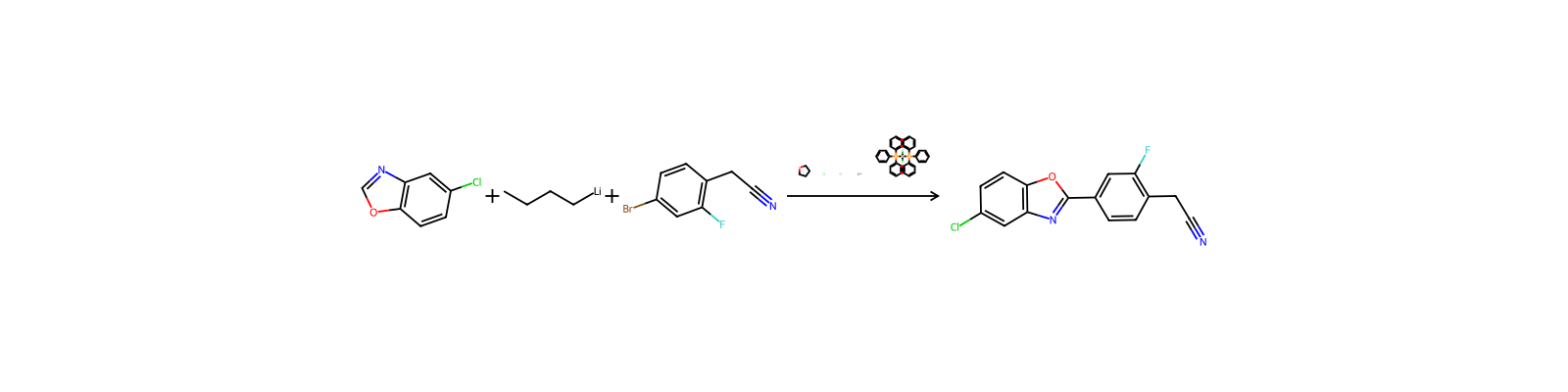
5-Chlorobenzoxazole → [4-(5-Chloro-1,3-benzoxazol-2-yl)-2-fluorophenyl]acetonitrile
https://huagongshe.com/reaction/7705
Participants
| Role | Name | HCID | Charge |
|---|
| Reactant | 5-Chlorobenzoxazole | HCID 28398 | — |
| Reactant | 2-(4-Bromo-2-fluorophenyl)acetonitrile | HCID 7172308 | — |
| Reactant | Butyllithium | HCID 178418339 | — |
| Catalyst | Zincchloride | HCID 3007855 | — |
| Catalyst | HCID 178418476 | HCID 178418476 | — |
| Solvent | Tetrahydrofuran | HCID 8028 | — |
| Product | [4-(5-Chloro-1,3-benzoxazol-2-yl)-2-fluorophenyl]acetonitrile | HCID 21990953 | — |
Reaction Steps
To a stirred solution of 5-chlorobenzoxazole (200 mg, 1.3 mmol) in 5 mL THF at −78° C., was added n-Butyllithium (640 μL, 2.5M in hexane, 1.6 mmol). The reaction was stirred for 15 min at −78° C. followed by the addition of ZnCl2 (3.9 mL, 1M in Et2O, 3.9 mmol) via a syringe. The reaction was then warmed at 0° C. for 1 h. A solution of 4-bromo-2-fluoro benzyl cyanide (214 mg, 1.0 mmol) in THF (2 mL) was added, along with Pd0 (a fresh suspension prepared as follows: 200 μL, n-Butyllithium, 2.5M in hexanes added to 144 mg of PdCl2(PPh3)2 in 5 mL of THF). The reaction was then stirred at reflux overnight and quenched with sat. NaHCO3 (50 mL). After diluting the mixture with EtOAc (300 mL), the organic extract was washed with H2O (50 mL), dried (MgSO4), filtered and concentrated in vacuo. The residue was purified by flash chromatography (silica gel, hexanes:EtOAc 5:1) to afford the desired [4-(5-chloro-1,3-benzoxazol-2-yl)-2-fluorophenyl]acetonitrile as yellow solid. 1H NMR (CD3OD, 300 Hz), δ8.10(d, 1H), 7.99 (d, 1H), 7.79 (d, 1H), 7.68 (t, 1H), 7.52 (d, 1H), 7.39 (q, 1H), 3.90 (s, 1H). MS (ESI) 287 (M+H)+.
Provenance & Evidence
| DOI | 10.6084/m9.figshare.5104873.v1 |
|---|
| Patent number | US07087601B2 |
|---|
| Source dataset | uspto-grants-2006_08 |
|---|
| ORD ID | ord-c38c224bdbf645f49b58fc61a53b9b3d |
|---|
| Source note | uspto-grants-2006_08 |
|---|