HuagongsheHuagongshe Chemistry Print Report · For research reference only
HRID 79149Generated: October 26, 2026
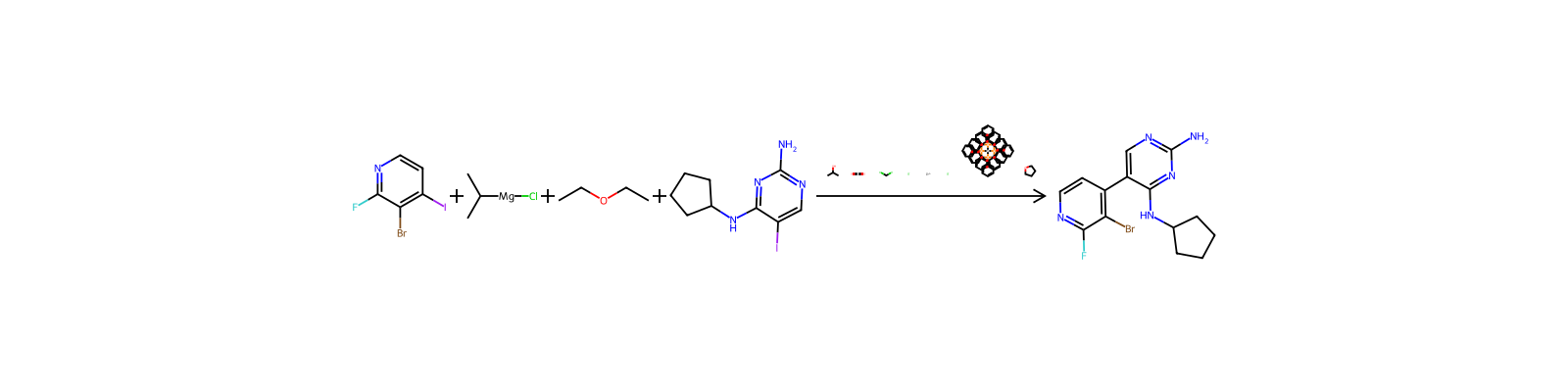
Diethyl Ether → 5-(3-Bromo-2-fluoro-4-pyridinyl)-N4-cyclopentyl-2,4-pyrimidinediamine
https://huagongshe.com/reaction/79149
Participants
| Role | Name | HCID | Charge |
|---|
| Reactant | Diethyl Ether | HCID 3283 | — |
| Reactant | 3-Bromo-2-fluoro-4-iodopyridine | HCID 40418629 | — |
| Reactant | N4-Cyclopentyl-5-iodo-2,4-pyrimidinediamine | HCID 58299581 | — |
| Reactant | HCID 178418918 | HCID 178418918 | — |
| Catalyst | Zincchloride | HCID 3007855 | — |
| Catalyst | HCID 178418397 | HCID 178418397 | — |
| Solvent | Dichloromethane | HCID 6344 | — |
| Solvent | Tetrahydrofuran | HCID 8028 | — |
| Solvent | Isopropanol carbon dioxide | HCID 86586944 | — |
| Product | 5-(3-Bromo-2-fluoro-4-pyridinyl)-N4-cyclopentyl-2,4-pyrimidinediamine | HCID 58299840 | 81.6% |
Reaction Steps
In a dry 3 neck 2 L flask equipped with a dry addition funnel, thermometer and stir bar was added 3-bromo-2-fluoro-4-iodopyridine (83.4 g, 276 mmol) followed by 300 mL of anhydrous THF under an atmosphere of nitrogen. The solution was cooled to −70° C. in 2-propanol/dry ice bath. A solution of isopropylmagnesium chloride 2.0 M in diethyl ether (145 mL, 290 mmol) was added drop wise over a period of 30 minutes. The solution was then stirred for 30 minutes before zinc (II) chloride 0.5 M in THF (276 mL, 138 mmol) was cannulated in. The solution was warmed to room temperature and stirred for 1 hour. The addition funnel was replaced with a reflux condenser and N4-cyclopentyl-5-iodopyrimidine-2,4-diamine (243, see example 200) (28.00 g, 92.1 mmol) was added, followed by Pd(PPh3)4 (5.32 g, 4.60 mmol). The solution was heated over night at a gentle reflux. After concentrating the solution to 1/10th of the volume under vacuum, it was cooled in an ice bath. To this was added 100 mL of cold saturated NH4Cl, followed by 500 mL of water. 500 mL of 12% isopropanol/DCM was then added and the solution was stirred at room temperature for 1 hour before being filtered through filter paper. The filter cake was washed in succession with water, DCM and 12% 2-propanol/DCM. The filtrate was partitioned in a separation funnel and the aqueous layer was washed with 12% 2-propanol /DCM. The organics were dried over MgSO4 and then concentrated under vacuum. The residue obtained was partially dissolved in DCM with sonication and filtered off to give compound 244 (26.45 g, 81.6%) as a light yellow solid. 1H NMR (500 MHz, DMSO-d6) δ ppm 8.18 (1 H, d, J=4.9 Hz), 7.52 (1 H, s), 7.26 (1 H, dd, J=4.9, 0.7 Hz), 6.34 (2 H, s), 6.12 (1 H, d, J=7.6 Hz), 4.42 (1 H, sxt, J=7.4 Hz), 1.76-1.96 (2 H, m), 1.55-1.68 (2 H, m), 1.31-1.53 (4 H, m)) ppm; LCMS-ESI (POS), M/Z, M+1: Found 352.0.
Provenance & Evidence
| DOI | 10.6084/m9.figshare.5104873.v1 |
|---|
| Patent number | US08841312B2 |
|---|
| Source dataset | uspto-grants-2014_09 |
|---|
| ORD ID | ord-3cc1fdee9e584424955d8cf8fdb2e19b |
|---|
| Source note | uspto-grants-2014_09 |
|---|