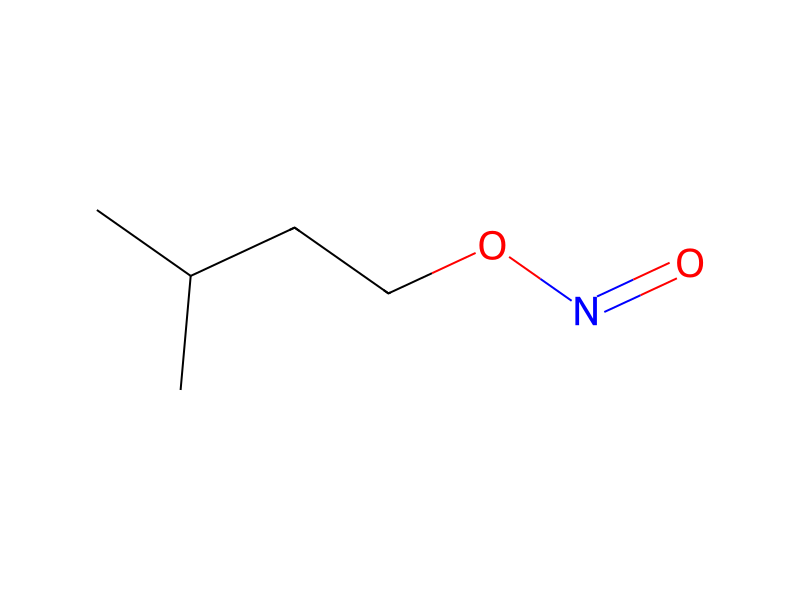
Isoamyl Nitrite → 1-(4-bromo-2-methylsulfanyl-phenyl)-5-methyl-1H-tetrazole
Reaction equation

N(OCCC(C)C)=O.CS[S:11][CH3:12].[Br:13][C:14]1[CH:15]=[CH:16][C:17]([N:21]2[C:25]([CH3:26])=[N:24][N:23]=[N:22]2)=[C:18](N)[CH:19]=1>>[Br:13][C:14]1[CH:19]=[CH:18][C:17]([N:21]2[C:25]([CH3:26])=[N:24][N:23]=[N:22]2)=[C:16]([S:11][CH3:12])[CH:15]=1Participants


Conditions
- Temperature
- 85 °C
Procedure
A solution of isoamyl nitrite (402 μL, 3 mmol) in dimethyl disulfide (2 mL, 22 mmol) at 25° C. was slowly treated with 5-bromo-2-(5-methyl-tetrazol-1-yl)-phenylamine (0.51 g, 2 mmol). The reaction was exothermic with gas evolution. The resulting brown reaction mixture was heated to 80-90° C. for 2 h, at which time, thin layer chromatography analysis of the reaction mixture indicated the absence of starting material. The reaction mixture was cooled to 25° C. and then concentrated in vacuo. The resulting residue was dissolved in ethyl acetate (50 mL). The organic layer was washed successively with a 1N aqueous hydrochloric acid solution (1×50 mL) and a saturated aqueous sodium chloride solution (1×50 mL), dried over anhydrous magnesium sulfate, filtered, and concentrated in vacuo. Biotage chromatography (FLASH 40M, Silica, 6/1 to 5/1 hexanes/ethyl acetate) afforded 1-(4-bromo-2-methylsulfanyl-phenyl)-5-methyl-1H-tetrazole (0.8 g) as a brown solid that was used without further purification and characterization.
Workup
- temperatureThe reaction mixture was cooled to 25° C.
- concentrationconcentrated in vacuo
- dissolutionThe resulting residue was dissolved in ethyl acetate (50 mL)
- washThe organic layer was washed successively with a 1N aqueous hydrochloric acid solution (1×50 mL)
- dry with materiala saturated aqueous sodium chloride solution (1×50 mL), dried over anhydrous magnesium sulfate
- filtrationfiltered
- concentrationconcentrated in vacuo
Sources & evidence
- ORD record
- ord-918a5e89c2004c6c99b4c2aa19ab0571
- Source dataset
- uspto-grants-2002_04
- Patent number
- US06369232B1
Reaction notes
Loading…