HuagongsheHuagongshe Chemistry Print Report · For research reference only
HRID 843229Generated: October 25, 2026
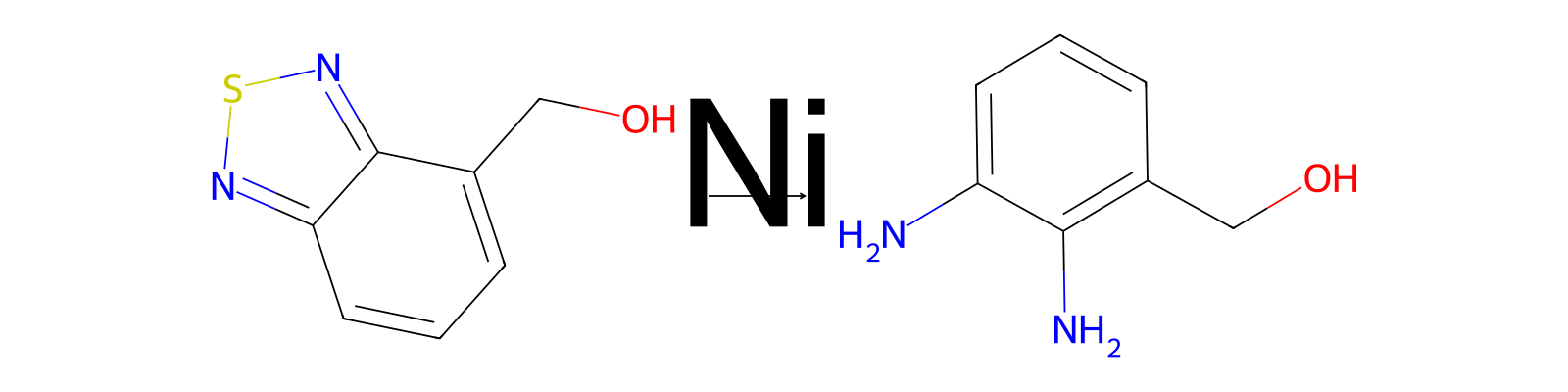
(2,1,3-Benzothiadiazol-4-yl)methanol → (2,3-Diaminophenyl)methanol
https://huagongshe.com/reaction/843229
Participants
| Role | Name | HCID | Charge |
|---|
| Reactant | (2,1,3-Benzothiadiazol-4-yl)methanol | HCID 10012273 | — |
| Catalyst | Nickel | HCID 935 | — |
| Product | (2,3-Diaminophenyl)methanol | HCID 1514188 | — |
Reaction Steps
A procedure for preparing a BBZ ligand and its related metal complex is shown in FIG. 2. The precursor, 4-hydroxymethyl-2,1,3-benzothiadiazole 1,56 was reduced with Raney nickel to yield 2,3-diaminobenzyl alcohol 2. Using the copper acetate coupling conditions,55 the phenylbenzimidazole backbone was formed from reaction of the 2,3-diaminobenzyl alcohol 2 with 2-nitrophenyl-1-carboxaldehyde in 82% yield. The benzyl alcohol group of 3 was oxidized to the corresponding aldehyde by manganese dioxide and then protected as the acetal 5. With both the aldehyde protected as the acetal and the amine protected as the nitro group, substitution at the benzimidazole nitrogen position can be achieved fairly easily. For example, a methyl group can be added by treatment of 5 with methyl iodide in the presence of sodium hydride. Other substituents have also been added via similar procedures, providing for a wide range of bis-benzimidazole derivatives. Reduction of the nitro group of 6 with hydrogen, catalyzed by Pd on carbon, followed by the addition of perchloric acid, unmasked both the amine and carboxaldehyde functionalities. Dimerization and cyclization of the resulting precursor gave the desired Me2BBZ ligand.
Provenance & Evidence
| DOI | 10.6084/m9.figshare.5104873.v1 |
|---|
| Patent number | US06376664B1 |
|---|
| Source dataset | uspto-grants-2002_04 |
|---|
| ORD ID | ord-663d56fd777545be811d6385a4525fab |
|---|
| Source note | uspto-grants-2002_04 |
|---|