Formaldehyde → Formaldehyde;phenol
Reaction equation

[C:1]1([OH:7])[CH:6]=[CH:5][CH:4]=[CH:3][CH:2]=1.C(O)(=O)C(O)=O.C=O>>[CH2:1]=[O:7].[C:1]1([OH:7])[CH:6]=[CH:5][CH:4]=[CH:3][CH:2]=1Participants

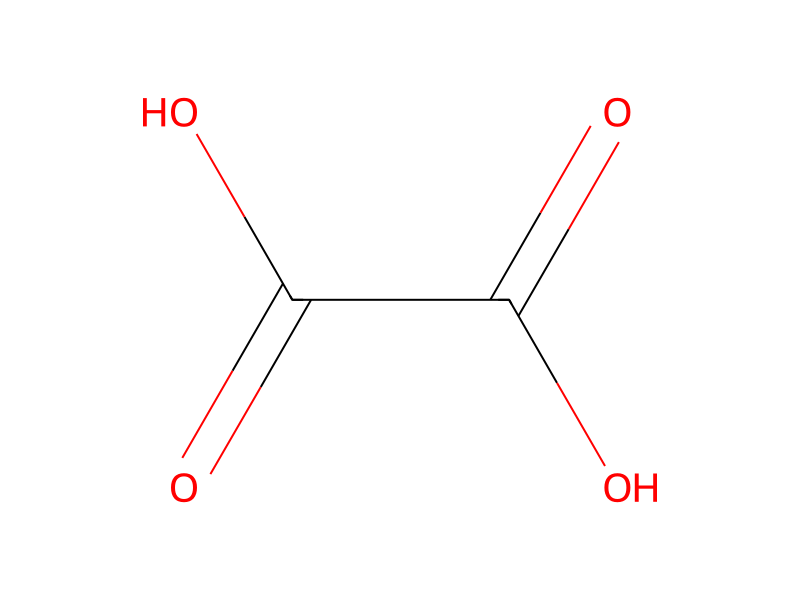


Conditions
- Temperature
- 110 °C
Procedure
A glass reactor equipped with a stirrer, reflux condenser, addition funnel, and a device for controlling temperature was charged with 550 grams (5.85 moles) of phenol and 2.75 grams (0.03 mole) of oxalic acid. This mixture was heated to 110° C., and 298.8 grams (3.68 moles) of formalin, 37% aqueous formaldehyde, was slowly added during approximately 60 minutes (3600 s). The reaction mixture was allowed to reflux during the formalin addition, and for about 60 minutes (3600 s) thereafter. A vacuum was then applied, and the excess phenol and water were removed by vacuum distillation at a final temperature of 180° C. The solid novolac resin had a Mettler softening point of 87.9° C., analysis by gel permeation chromatography (GPC) showed the product to have a wt. avg. M.W. of 1,044, a no. avg. M.W. of 700, with a polydispersity of 1.49. The product contained 16.3% 2-functional components, and the ratio of 2-functional to 3-functional was 1.2 to 1.0.
Workup
- customA glass reactor equipped with a stirrer
- temperaturereflux
- additioncondenser, addition funnel
- customthe excess phenol and water were removed by vacuum distillation at a final temperature of 180° C
- customa Mettler softening point of 87.9° C., analysis
Sources & evidence
- ORD record
- ord-f36e81d30eb24155b70dfd1fd92ce833
- Source dataset
- uspto-grants-1988_07
- Patent number
- US04755543
Reaction notes
Loading…