O-Phenylenediamine → 1,3‐Dihydrospiro[1,3‐benzodiazole‐2,1'‐ cyclohexane]
Reaction equation

[C:1]1([NH2:8])[CH:6]=[CH:5][CH:4]=[CH:3][C:2]=1[NH2:7].[C:9]1(=O)[CH2:14][CH2:13][CH2:12][CH2:11][CH2:10]1>O>[C:9]12([NH:8][C:1]3[CH:6]=[CH:5][CH:4]=[CH:3][C:2]=3[NH:7]1)[CH2:14][CH2:13][CH2:12][CH2:11][CH2:10]2Participants
Reactant 2
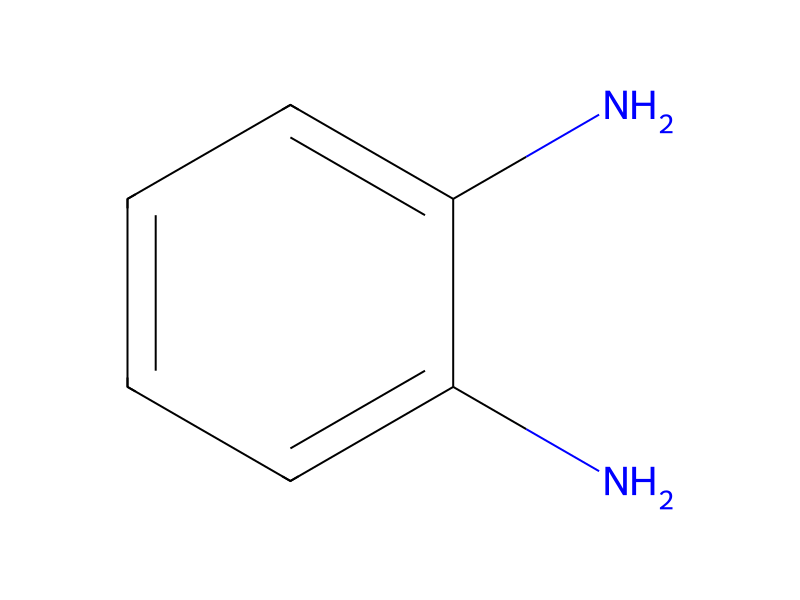

Product 1

Reagents, catalysts & solvents 1

Procedure
In a procedure similar to that described by H. Suschitszky in Croatica Chemica Acta, 59, 57-77 (1986), o-phenylenediamine (108 g, 1.0 mol) was dissolved in 1 liter hot water on a steam bath. With vigorous stirring and heating, cyclohexanone (98 g, 1.0 mol) was added in a rapid stream. After 5 minutes a brown gum formed; after 15 minutes a solid resulted. Stirring was continued for a total of 35 minutes. The slurry was cooled in an ice bath and then filtered to yield 112 g (59.5%) 1,3-dihydrobenzimidazole-2-spirocyclohexane. To a stirred solution of this compound (50 g, 0.266 mol) in 1 liter dichloromethane chloride was added, in several portions, 100 g MnO2. The resulting slurry was stirred vigorously for 30 minutes and filtered. The solids were washed with dichloromethane and the filtrate evaporated to obtain an oil. The oil was dissolved in 200 ml, ligroin, and the solution cooled to -10° C. The resulting solid was filtered to yield 46 g (93%) 2H-benzimidazole-2-spirocyclohexane. A solution of 2-chloroethyl methyl sulfide (19.8 g, 0.20 mol) and thiourea (15.2 g, 0.20 mol) in 50 ml absolute alcohol was refluxed for 6 hours. To this was added a solution of KOH (22.4 g, 0.40 mol) in 100 ml methanol, and the resulting slurry refluxed for 45 minutes. After cooling to 30°, 37.2 g (0.20 mol) of freshly prepared 2H-benzimidazole-2-spirocyclohexane was added in portions. The mixture was stirred at room temperature for 10 minutes and then at reflux for 2 minutes. After cooling, the mixture was evaporated to a thick slurry; 100 ml dichloromethane was added and the mixture evaporated. This was repeated and the residue treated with 100 ml water and 200 ml dichloromethane. The organic layer was separated, washed with water, dried over MgSO4, filtered and evaporated. The residue was chromatographed through silica gel using an increasingly polar mixture of dichloromethane and acetonitrile. Product fractions were combined and evaporated to give 7.0 g 5'-(2-methylthioethylthio)-1',2'-phenylenediamine. A stirred solution of the phenylenediamine (5.0 g, 0.027 mol) in 50 ml acetic acid was treated with sodium nitrite (2.6 g, 0.037 mol), in 5 ml water, over 30 seconds at room temperature. The mixture was stirred for 15 minutes and then evaporated. The residue was treated with 50 ml water and 50 ml dichloromethane. The organic layer was dried over MgSO4, filtered, and evaporated. Solid was chromatographed through silica gel using an increasingly polar mixture of dichloromethane chloride and acetone. The isolated product was recrystallized from ethyl acetate to yield 3.2 g (62%) 6'-(2-methyl-thioethylthio)benzotriazole, I-139.
Workup
- temperatureheating
- customAfter 5 minutes a brown gum formed
- customafter 15 minutes a solid resulted
- stirringStirring
- customwas continued for a total of 35 minutes
- temperatureThe slurry was cooled in an ice bath
- filtrationfiltered
Sources & evidence
- ORD record
- ord-5c274bbc02c646c5b7a2a582424dc4a9
- Source dataset
- uspto-grants-1992_08
- Patent number
- US05135839
Reaction notes
Loading…