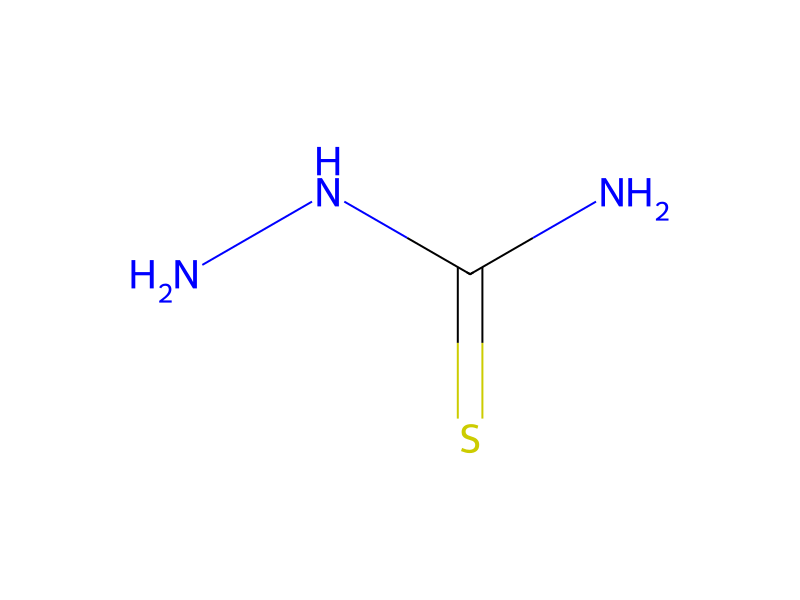
Thiosemicarbazide → (8-Bromo-4,5-dihydro-6-oxa-3-thia-1-aza-benzo[e]azulen-2-yl)-hydrazine
Reaction equation

Br[CH:2]1[CH2:8][CH2:7][O:6][C:5]2[CH:9]=[C:10]([Br:13])[CH:11]=[CH:12][C:4]=2[C:3]1=O.[NH2:15][NH:16][C:17]([NH2:19])=[S:18]>>[Br:13][C:10]1[CH:11]=[CH:12][C:4]2[C:3]3[N:19]=[C:17]([NH:16][NH2:15])[S:18][C:2]=3[CH2:8][CH2:7][O:6][C:5]=2[CH:9]=1Participants
3


Procedure
A solution of 4,8-dibromo-3,4-dihydro-2H-benzo[b]oxepin-5-one (1.5 g, 4.7 mmol) and thiosemicarbazide (455 mg, 5 mmol) in IMS (15 mL) was stirred at 85° C. for 2 h, allowed to cool down to RT and filtered to give the title compound as a beige solid (1.03 g, 70%). LCMS (Method B): RT=3.06 min, [M+H]+=312 and 314. 1H NMR (DMSO-d6): 10.10 (2 H, bs), 9.80 (1 H, bs), 8.27 (1 H, d, J=8.6 Hz), 7.34 (1 H, dd, J=8.6, 2.1 Hz), 7.22 (1 H, d, J=2.1 Hz), 4.31 (2 H, t, J=5.0 Hz), 3.19 (2 H, t, J=5.0 Hz).
Workup
- filtrationfiltered
Sources & evidence
- ORD record
- ord-2b2189e6bfc44e5a8dfb146bced65eac
- Source dataset
- uspto-grants-2014_09
- Patent number
- US08846762B2
Reaction notes
Loading…