Propylene → Vinylcyclohexane Propylene
Reaction equation

[CH:1]([CH:3]1[CH2:8][CH2:7][CH2:6][CH2:5][CH2:4]1)=[CH2:2].[CH2:9]=[CH:10][CH3:11].[H][H]>CCCCCCC>[CH:1]([CH:3]1[CH2:8][CH2:7][CH2:6][CH2:5][CH2:4]1)=[CH2:2].[CH2:9]=[CH:10][CH3:11]Participants
Reactant 3
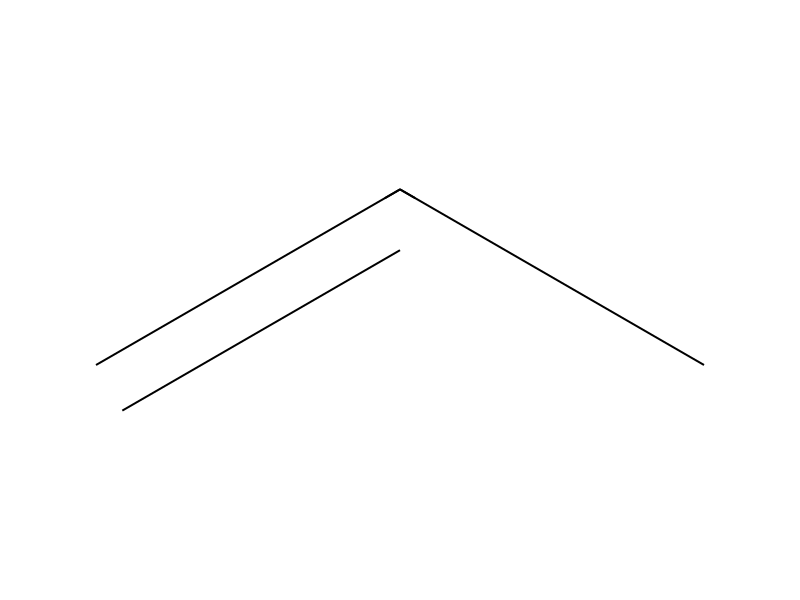


Product 1

Reagents, catalysts & solvents 1

Procedure
Subsequently, in a 3 l-volume SUS-made autoclave equipped with a stirrer whose atmosphere had been displaced with nitrogen were successively charged 1 l of dehydration-purified n-heptane, 8.5 mmol of an organoaluminum compound of formula (C2H5)2Al(OBu)0.3 Cl0.7, 0.85 mmol of methyl toluylate, and 3.44 g of the above-obtained solid catalyst containing the vinylcyclohexane polymer. To the mixture were fed 50 g of propylene and hydrogen at a partial pressure 1.5 atm. to effect polymerization at 60° C. for 4 hours. During the polymerization, propylene was fed so as to maintain the polymerization pressure at 6 kg/cm2G. The polymerization was terminated by addition of 50 ml of butanol, and the inner pressure was released, followed by allowing to stand at 60° C. for 1 hour. The polymerization mixture was taken out and filtered to obtain 233 g of a vinyl-cyclohexane-propylene block copolymer. The polymer had an Mw/Mn of 11.8, a CXS of 1.8%, and an [η] of 1.81 dl/g and contained 13400 ppm of the vinylcyclohexane polymer component.
Workup
- customSubsequently, in a 3 l-volume SUS-made autoclave equipped with a stirrer whose atmosphere
- custompolymerization at 60° C. for 4 hours
- temperatureto maintain
- customthe polymerization pressure at 6 kg/cm2G
- customThe polymerization was terminated by addition of 50 ml of butanol
- filtrationfiltered
Sources & evidence
- ORD record
- ord-5c004be48deb4795a9f3889ab1c9752b
- Source dataset
- uspto-grants-1992_08
- Patent number
- US05141994
Reaction notes
Loading…